
A commercial property manager on King Street, a contractor pricing a build near the Bridgewater Mall, and a homeowner a few streets back from the LaHave River are asking different questions, but they share one starting point: Bridgewater's electrical needs are shaped by its river, its coastline, and a downtown that is older than the retail strip across the water. Planning around that, rather than around a generic checklist, is what keeps a project from becoming a service call two winters later.
A town built in two eras
Bridgewater calls itself the Main Street of the South Shore, and the description holds up. It is the commercial and professional hub for a large rural stretch of the South Shore, which means its building stock spans two distinct periods. The King Street core on the west side of the LaHave River is the traditional downtown: older buildings, often with services and panels installed decades ago, serving shops and offices that were not built for today's electrical load. On the east side, the Bridgewater Mall, Eastside Plaza, and the surrounding retail development are newer, but newer does not always mean adequately provisioned. Retail tenants now expect higher-capacity circuits for point-of-sale systems, refrigeration, and EV charging that a plaza built even fifteen years ago may not have planned for.
Neither situation calls for guesswork. An older King Street building needs a load assessment before a panel upgrade gets specified, not after. A newer retail space needs its electrical designed against what tenants will actually plug in over the next decade, not just what the first tenant needed.
What the LaHave River adds to the plan
Bridgewater sits about 20 kilometres inland from the mouth of the LaHave River estuary, which makes it what planners call an inland coastal community: it can flood from river runoff, from storm surge riding in on high tide, or from both at once. A storm surge flooded downtown Bridgewater in October 2011, and the town has documented flood risk tied to hurricanes and post-tropical storms working up the Atlantic coast. The municipality has since put substantial money into stormwater and wastewater upgrades to manage that exposure. None of that is a reason for alarm. It is a reason to treat backup power and moisture-rated equipment as standard planning for anything near the river or the harbour, not an upgrade you add after the first outage.
Salt air off the Atlantic and freeze-thaw cycling through a Nova Scotia winter both work on outdoor electrical equipment over time. Panels, disconnects, and anything mounted outside or at grade near the water should go in with corrosion-resistant hardware and proper sealing from the start.
Commercial work that fits Bridgewater
For property managers and GC estimators, the work that comes up most in a town like this includes:
- Panel and service upgrades in older King Street buildings, sized for current and near-future tenant load
- Tenant fit-outs and retail buildouts on the east side, coordinated with the rest of a build rather than bolted on afterward
- EV charging for retail plazas and mall parking, which draws customers who might otherwise stop somewhere else
- Emergency service planning for buildings that cannot afford a flood-related outage to sit unresolved, including backup power sized to keep critical systems running
Residential work along the South Shore
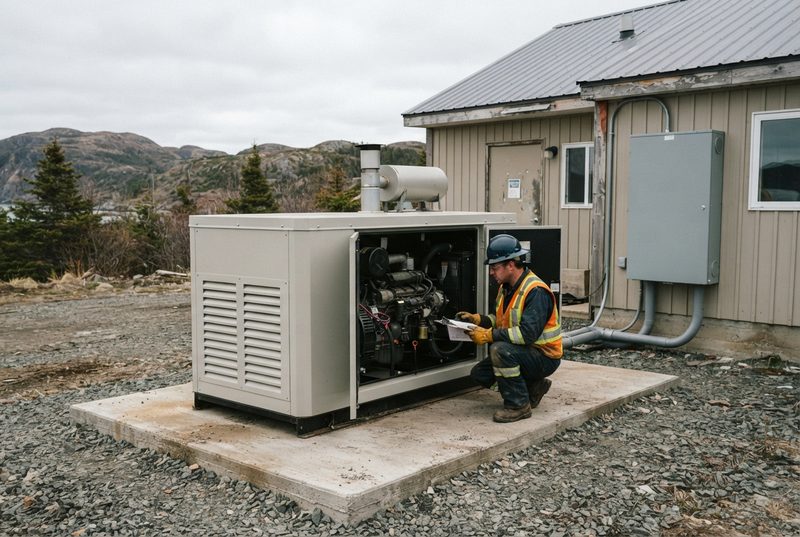
Homeowners near the river or along the coast face a narrower but real set of decisions. A generator sized to carry a home through a storm-related outage is a reasonable response to a place that sees real storm surge and river flood risk. Puffin Power is an authorized Generac dealer, and can spec a unit against your home's actual load rather than a guess.
Some things are worth calling a professional about right away rather than waiting: a panel that feels warm to the touch, breakers that trip repeatedly, flickering lights that are not tied to a storm, or any smell of burning near an outlet or panel. None of those are things to investigate yourself with the power live. They are reasons to call an electrician. For general upgrades, from panel work to heat pump wiring as more South Shore homes convert their heating, plan the work around your home's age and location rather than a standard package.
Infrastructure already taking shape here
Bridgewater is also where Nova Scotia Power, the province's utility, has installed a large-scale battery storage system as part of a provincewide push to modernize the grid. That is a sign the area already carries real grid infrastructure, not just retail and homes. For any commercial or infrastructure project that needs switchgear, underground service runs, or stamped engineering drawings, Puffin Power's design-build process draws on a partner professional engineer who can stamp drawings across Canada, which matters for anything beyond a straightforward tenant fit-out.
Puffin Power is licensed in Newfoundland and Labrador and serves Bridgewater and the rest of the South Shore from its base in Conception Bay South. Licensing status in Nova Scotia should be confirmed directly, and any project here should also be checked against your provincial electrical inspection authority and the Canadian Electrical Code before work begins.
Talk to Puffin Power
If you are planning electrical work in Bridgewater, whether it is a downtown panel upgrade, a retail fit-out, or a generator for a home near the river, ask about scheduling and scope before you commit to a design. Reach Puffin Power through /contact.html or by phone at (709) 769-9713.
Published 2026-09-23 · About 4 minute read