
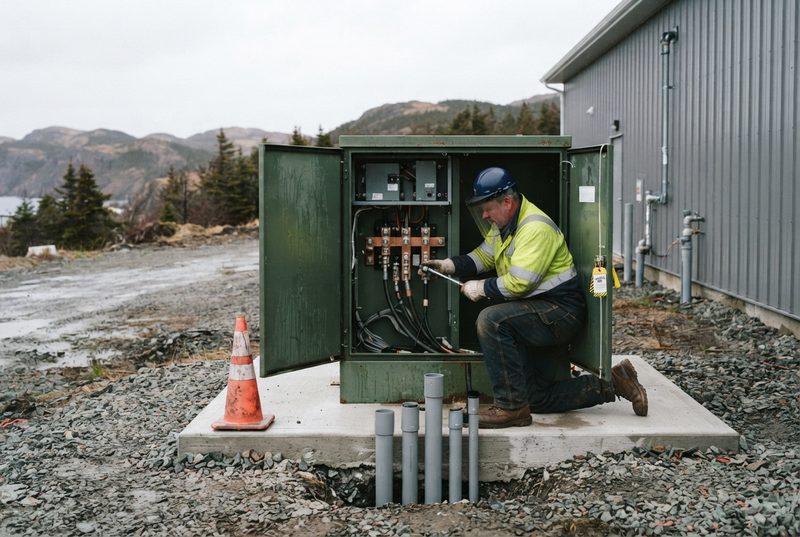
Happy Valley-Goose Bay is the largest population centre in Labrador and functions as the hub for Central Labrador, serving communities across the region and hosting 5 Wing Goose Bay, a Royal Canadian Air Force base still active in North American air defence and allied training. It sits at the western end of Lake Melville, and its climate is a different problem entirely from anything on the island. Winters here regularly drop to minus 30 degrees Celsius or colder, and the coldest temperature on record for the town, set in February 1973, was minus 39.4 degrees. That kind of cold, combined with how the community gets its power, is worth understanding before starting any electrical project here.
A different kind of grid
Newfoundland and Labrador Hydro serves Happy Valley-Goose Bay, and the town's power supply is not connected to the same integrated system that runs across the island. Hydro operates a gas turbine generation facility in the community, which also serves as backup capacity for the Lower Churchill hydroelectric system. More broadly, Labrador and coastal Newfoundland include a number of isolated electrical systems that are not tied into the main island grid, a structural reality that matters for how a building owner here thinks about resilience. A grid interruption in an isolated system does not necessarily get backed up by drawing more power from somewhere else on the same network the way it might on the island.
Extreme cold changes the electrical math
At minus 30 and colder, every part of a building's electrical and heating system is working harder, for longer stretches, than equipment anywhere on the island typically has to. Standby generators, heating circuits and even basic wiring need to be specified for that reality rather than a milder provincial average. A generator sized adequately for a coastal Newfoundland home during a storm may not carry a Happy Valley-Goose Bay household through an extended cold snap if the grid is also down, since heating demand alone climbs sharply in that kind of cold.
A hub for a much wider region
Happy Valley-Goose Bay does not just serve its own residents. It is the gateway community for Central Labrador, connecting surrounding communities to the services, retail and transportation that a town of its size supports. That role means the town's electrical and mechanical infrastructure carries a wider load than its own population would suggest, and it means building owners here, particularly commercial ones, are effectively serving a much larger catchment than the town limits. A construction or renovation project in Happy Valley-Goose Bay is also working against a shorter building season than milder parts of the province, since the ground stays frozen for a longer stretch of the year here than almost anywhere on the island.
What this means for the community
Homeowners in Happy Valley-Goose Bay should treat a properly sized standby generator with an automatic transfer switch as a serious consideration given both the extreme cold and the isolated nature of the local grid, not an occasional-use convenience. Our residential work includes generator sizing built around a home's actual heating and critical-circuit load.
Commercial and institutional property owners, including businesses supporting the base and the wider Central Labrador region, should plan backup power and emergency lighting with the understanding that an outage here can last longer and matter more than a comparable outage on the island grid. Our emergency service work covers that kind of planning directly.
Anyone doing underground or site electrical work in Happy Valley-Goose Bay needs a plan that accounts for how deep and how long the ground stays frozen through the winter, which affects scheduling for any buried conduit, duct bank or grounding work. Our underground infrastructure work is built around exactly that kind of seasonal constraint.
Because Puffin Power's engineering and stamped drawings come through a partner professional engineer able to stamp work across Canada, projects in Labrador are supported the same way projects on the island are, even though the community sits outside the main provincial grid.
Talk to Puffin Power
Puffin Power serves Happy Valley-Goose Bay and Central Labrador from its base in Conception Bay South. If you are planning a project here, get in touch or call (709) 769-9713 to talk about scheduling and backup power sized for the local climate.
Published 2026-09-23 · About 3 minute read