
Labrador City sits above the 53rd parallel and carries a subarctic climate that is unlike anywhere else on this list. Snowfall here can exceed four metres in a typical winter, with snow on the ground for the better part of seven months, and the coldest temperature ever recorded in the town, set in February 1973, was minus 47.8 degrees Celsius. The town exists because of iron ore: the Iron Ore Company of Canada has mined the area since the 1950s, and the community's population has moved with the mine's fortunes ever since, currently sitting around 12,000 people across Labrador City and neighbouring Wabush. Every electrical system in this town, residential or commercial, is built against that backdrop of extreme cold and a local economy tied to one industry.
Labrador City was not a community that grew up gradually, it was planned from the start. The Iron Ore Company laid out the town in 1959 with curvilinear streets around Little Wabush Lake, deliberately preserving stretches of the surrounding taiga woodland between blocks rather than clearing the site entirely, and construction crews built out the town specifically to house the workforce a new mine would need. That planned layout, and the housing stock that came with it, is still what most of Labrador City's residential electrical work is dealing with today: homes built quickly, in a short window, to a standard set for a company town rather than a slowly built organic community.
Power with deep local roots
Labrador City's power history runs directly through the mining industry that built the town. The Menihek hydroelectric station, originally built in 1954 by the Iron Ore Company to power its operations, was transferred to Newfoundland and Labrador Hydro in 2007 and remains part of the region's generation today, alongside the historic Twin Falls development that once supplied Labrador City and Wabush directly. Newfoundland and Labrador Hydro serves the town now, and that history is worth knowing because it explains why the local grid was built the way it was: to support heavy industrial load first, with the town's residential and commercial growth following alongside it.
Puffin Power does not take on work inside active industrial plants, so mine-site shutdown work is outside our scope here. What does fall inside it is everything the rest of the town runs on: homes, commercial buildings, and the infrastructure that supports a community built to withstand a genuinely extreme climate.
Cold at this level changes every calculation
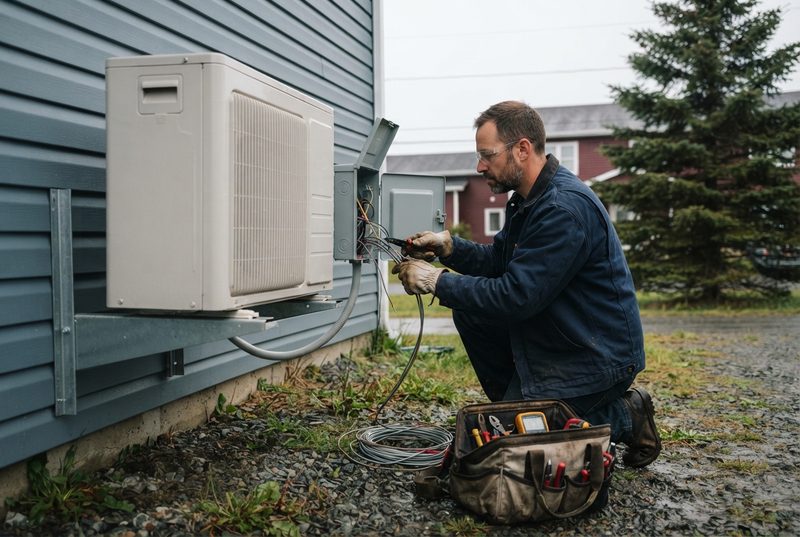
At minus 40 and colder, a building's electrical system is not just supplying lights and outlets, it is central to keeping the building survivable. Heating circuits need to be sized for sustained extreme cold, not an average winter. Heat pump systems, which have become viable even in cold Canadian climates with modern equipment, still need a wiring and backup plan that accounts for what happens on the coldest nights of the year, when a heat pump's output can drop and supplemental electric heat needs to pick up the difference reliably. Standby generation matters even more here than in milder parts of the province, since a power outage during a cold snap is a much shorter runway before pipes and occupants are both at risk.
What this means for Labrador City
Homeowners should have their panel and heating circuits assessed with the town's actual winter extremes in mind, not a generic provincial specification. A residential electrical assessment that accounts for both a heat pump and a backup heating source is worth doing before the coldest months arrive, not during them.
Commercial and institutional building owners serving the town's mining-dependent population should treat backup power and service capacity as core infrastructure, not an optional upgrade, given how much colder and longer the local winter runs compared to the island. Our low and high voltage work supports that kind of commercial-scale planning.
Anyone doing site or underground work in Labrador City needs a schedule built around a shorter construction season and deeper, longer-lasting ground frost than almost anywhere else in the province covered here. Our underground infrastructure work plans around exactly that constraint.
Talk to Puffin Power
Puffin Power serves Labrador City from its base in Conception Bay South, supporting residential, commercial and infrastructure electrical work outside the mine site itself. Get in touch or call (709) 769-9713 to talk through a project built for this climate.
Published 2026-09-23 · About 3 minute read