
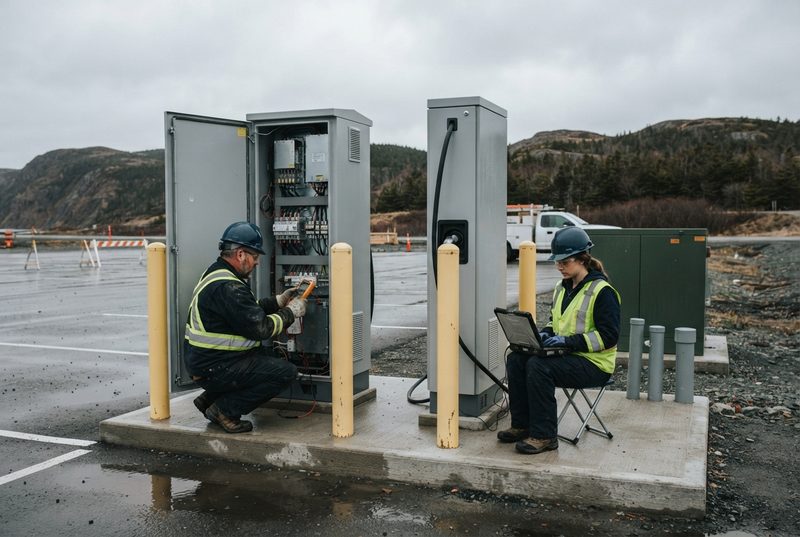
Property owners installing EV charging in Atlantic Canada are planning for a climate that includes freezing rain, heavy snow, salt exposure near the coast, and temperature swings that affect both vehicles and equipment. Charging infrastructure that works fine in a mild climate does not always hold up the same way here, and it is worth planning for the actual conditions rather than a general specification sheet.
Equipment rated for the climate
Not all EV chargers are built the same for outdoor, cold-weather use. When selecting equipment for an outdoor installation, look for chargers rated for the temperature range your site actually experiences, with enclosures designed to keep out driven snow and moisture rather than just light rain. Charging cables and connectors also vary in how well they handle stiffening in cold temperatures, which affects how easily a driver can handle the cable in January versus July. An electrical contractor familiar with the equipment available can point you toward units with a track record in Atlantic Canada conditions rather than ones tested primarily for milder climates.
Siting matters as much as equipment
Where a charger is placed affects how well it holds up and how usable it stays through winter.
- Avoid locations directly under roof edges where snow and ice shed, which can damage equipment and create a hazard for anyone using the charger.
- Plan for snow clearing access, since a charger buried under a plow pile after the first storm does nobody any good.
- Consider some form of overhead protection where practical, particularly for higher-use commercial installations, to keep the connector and display accessible in freezing rain.
- Near the coast, factor in salt exposure on equipment and mounting hardware, the same way you would for any exterior electrical equipment in a coastal environment.
Underground infrastructure and frost
Any underground electrical work supporting EV charging, conduit runs from a building to a parking area, or feeds to a standalone charging station, needs to account for frost depth and ground movement common across the region. Conduit and cable buried without accounting for local frost conditions can be damaged by ground heave over successive freeze-thaw cycles. This is standard practice for underground electrical work generally, but it is worth confirming explicitly with your contractor when planning charging infrastructure, since the parking areas involved often see vehicle loading on top of the buried infrastructure as well.
Vehicle charging behaviour in cold weather
Beyond the equipment itself, it is worth knowing that electric vehicles generally charge more slowly in very cold temperatures and lose range faster in cold conditions, particularly when the battery has not been preconditioned. This is a vehicle characteristic more than an infrastructure one, but it affects planning for fleets and multi-unit buildings, where charging windows may need to run longer in winter months to fully charge the same number of vehicles.
Maintenance through the winter
Outdoor charging equipment benefits from periodic checks through the winter season: confirming connectors are free of ice buildup, checking that any heating elements in the equipment are functioning if the unit includes them, and clearing snow away from the base and any ventilation points on the unit. Building this into an existing winter maintenance routine, alongside snow clearing and lighting checks, is more reliable than treating it as a separate task that gets missed.
Planning ahead for the climate you actually have
None of this is a reason to avoid EV charging infrastructure in this region. It is a reason to plan for the conditions from the start, in equipment selection, siting and underground work, rather than installing to a generic specification and dealing with problems as winter reveals them.
A regional problem, not a rare one
Every winter in this region brings some combination of freezing rain, heavy wet snow and salt exposure, often within the same week. Treating that as the baseline condition to design for, rather than an occasional inconvenience, is what separates charging infrastructure that keeps working through a full Atlantic Canada winter from equipment that needs repeated attention once the temperature drops.
Talk to Puffin Power
Puffin Power installs EV charging infrastructure across Atlantic Canada built for the region's actual winter conditions. Contact us to discuss your site, or see our EV charging services.
Published 2026-09-23 · About 3 minute read