
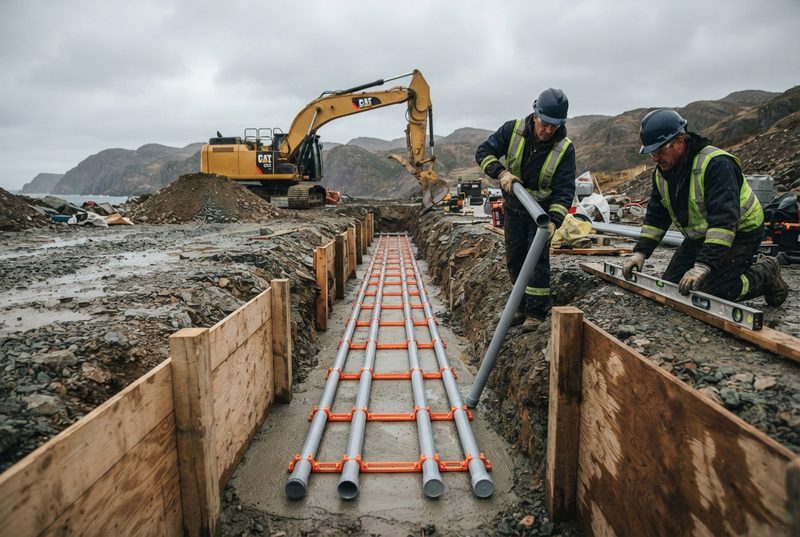
Underground electrical distribution on a development project usually runs through a duct bank: a run of conduits buried together, carrying power and sometimes communications cable between a service point, transformers, switchgear and buildings. The two main approaches, concrete-encased and direct-buried, come with different costs, different protection levels and different constraints.
What a duct bank actually is
A duct bank groups multiple conduits together in a single trench, each conduit carrying separate cables, with spacing maintained to manage heat and allow for future cable pulls. The conduits themselves are typically PVC or similar material. What differs between the two approaches is what surrounds them in the ground.
Concrete-encased duct banks
A concrete-encased duct bank has the conduits set in a form and poured in with concrete, creating a solid, rigid structure around them. This approach:
- Offers stronger physical protection against future digging, settling ground or heavy loads above, such as a parking area or roadway.
- Is generally the standard for higher-voltage circuits, critical infrastructure, and anywhere the consequence of future damage to the duct bank is severe.
- Costs more, both in materials and in the additional labour and time to form and pour the concrete correctly.
- Is harder to modify later. Adding a conduit or making a repair means breaking out concrete, not just re-opening a trench.
Direct-buried duct banks
A direct-buried duct bank places the conduits directly in the trench, typically surrounded by sand or select backfill rather than concrete, sometimes with a layer of protective material or marker tape above. This approach:
- Costs less and installs faster, since there is no formwork or concrete cure time involved.
- Is more straightforward to modify or repair later, since the conduits are easier to re-access.
- Offers less physical protection, which matters more in areas prone to future excavation, heavy vehicle loading, or ground movement.
- Is commonly used for lower-voltage distribution, residential subdivisions, and situations where the risk profile does not justify the added cost of concrete encasement.
What actually drives the decision
The choice usually comes down to a handful of practical factors:
- Voltage and criticality. Higher voltage circuits and anything serving critical infrastructure lean toward concrete encasement.
- What is above the duct bank. A roadway, parking area, or anywhere heavy vehicles will cross favours the added protection of concrete.
- Likelihood of future excavation nearby. An area that is likely to see other utility work or future construction benefits from the added protection and clearer as-built documentation.
- Budget and schedule. Concrete encasement adds cost and time to a project, which matters on a tight schedule or budget.
- Utility or code requirements. Some jurisdictions or utility specifications mandate concrete encasement for certain voltage levels or crossing conditions regardless of preference.
Coordination with civil work
Either approach needs coordination with civil contractors on timing, since duct banks typically go in before paving, landscaping or final grading. Getting this sequence wrong means expensive rework. This is one of the reasons underground infrastructure planning needs to happen early in a project, alongside site civil design, not as an afterthought once other trades are underway.
As-built documentation matters either way
Whichever method is used, accurate as-built drawings showing exact depth, location and routing of the duct bank are essential, since buried infrastructure is invisible the moment the trench is closed. This matters even more for direct-buried duct banks, since there is no concrete outline to indicate where conduits sit if drawings are lost or inaccurate. Future excavation near the site, whether for landscaping, another utility, or a future building phase, depends on those records being available and accurate. Locate markers, tracer wire, and GPS-referenced as-built surveys are all reasonable ways to reduce the risk of a future crew hitting a live duct bank by accident, which is both a safety hazard and an expensive repair.
Talk to Puffin Power
If your project needs underground duct bank design and installation, Puffin Power can help determine which approach fits your site, your loads and your budget. Call (709) 769-9713 or visit /contact.html.
Published 2026-09-23 · About 3 minute read