
If you are a commercial property manager in downtown Halifax, a GC estimator bidding a mixed-use project near the harbour, or a homeowner in an older neighbourhood off Quinpool or in the North End, you are dealing with the same underlying problem from different angles. Halifax's electrical infrastructure has to hold up against salt air and coastal weather, on buildings and housing stock that are being added or renovated faster than the city has seen in years. That combination changes what "good enough" wiring looks like.
A city building faster than its stock can absorb
Halifax is in the middle of a sustained construction run. Downtown towers are going up, older commercial buildings are being converted for new tenants, and the province has designated Special Planning Areas to fast-track housing approvals across the municipality, with tens of thousands of new units in the pipeline. Large mixed-use redevelopments, combining retail, housing and amenity space on one site, are also moving through approvals. For electrical planning, that means two realities at once: new buildings that need service sized correctly the first time, and a large base of older buildings whose systems were never designed for today's loads, especially as EV charging and heat pumps get added to panels that predate both.
This is where design-build matters more than a trade call after the drawings are fixed. When the electrical scope is worked out alongside the rest of the building design, load calculations, panel placement and future capacity get decided before conduit goes in the wall, not after. Puffin Power's design-build approach applies here the same way it does anywhere else: engineering sized to what the building will actually carry, not just what the permit requires today.
What the coastline does to a service
Halifax sits directly on the Atlantic, and that has a real effect on electrical equipment that has nothing to do with square footage or tenant count. Salt carried in sea air settles on outdoor and rooftop electrical components and keeps working on them long after a storm passes, since humidity reactivates the residue on metal surfaces. Municipal climate planning for the region also flags rising storm surge and coastal flood exposure as something building owners need to design around, not react to after the fact. Together, that means enclosures, connectors and any equipment mounted outdoors or at grade near the harbour need corrosion-resistant hardware and proper sealing from day one, and it means service entrances and below-grade runs are worth planning with flooding in mind, not placed wherever is convenient.
For commercial buildings, that shows up in switchgear selection, in how rooftop equipment is protected, and in whether underground service runs are installed with the depth and drainage to handle a wet climate over decades, not just to clear inspection once.
Commercial: capacity and continuity
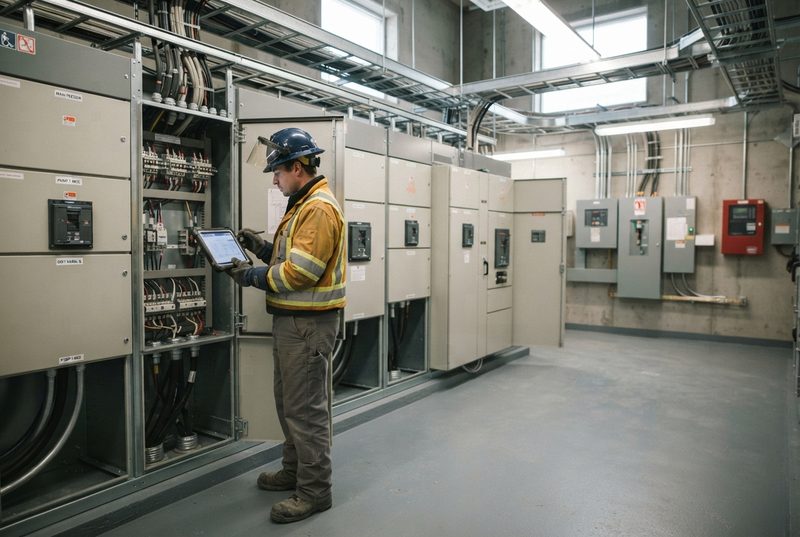
For property managers and GCs, the practical questions in Halifax tend to be about capacity and continuity. Is the existing service large enough for a tenant fit-out or a rooftop HVAC upgrade. Does the switchgear need replacing before it becomes the bottleneck on a lease deal. What happens to elevators, life safety and refrigeration during an outage, which on this coast is not a hypothetical. Puffin Power's turnkey electrical work covers this ground, from service upgrades through switchgear and standby power, including emergency calls that cannot wait for a scheduled visit.
Given how much commercial and mixed-use square footage is moving through approvals right now, EV charging is worth planning into a project early rather than retrofitting later. Parking structures and mixed-use retail sites are natural fits, and sizing the electrical room for future charger circuits during initial construction is far cheaper than trenching it in afterward. See EV charging for how that gets scoped.
Residential: older stock, newer expectations
A lot of Halifax's housing predates central air, EV ownership and modern kitchen loads. Adding a heat pump, an EV charger or a generator to a panel sized decades ago is one of the most common reasons a homeowner ends up needing an electrician rather than just an installer. If your panel is original to a pre-1980s house, if lights flicker when large appliances start, or if an installer tells you the panel needs attention before a heat pump or charger goes in, that is worth a proper assessment rather than a workaround. Puffin Power's residential work covers panel upgrades and the wiring that comes with them, and as an authorized Generac dealer, backup power is part of the same conversation for anyone tired of losing power every time a coastal storm rolls through.
Code and inspection
Electrical work in Nova Scotia is inspected under the province's Electrical Installation and Inspection Act, with wiring permits and inspections coordinated through the utility serving the property, Nova Scotia Power across most of the Halifax area. The work itself still has to meet the Canadian Electrical Code regardless of who inspects it. If you are unsure what triggers a permit for your project, that is a question for your provincial electrical inspection authority before work starts, not after.
Puffin Power is licensed in Newfoundland and Labrador and serves Halifax and the surrounding area from its base in Conception Bay South. Nova Scotia licensing for a given scope of work is not something to assume either way. Ask when you reach out, and the answer will be specific to your project.
Talk to Puffin Power
If you have a Halifax project, from a downtown tenant fit-out to a home panel upgrade, call (709) 769-9713 or reach out through contact.html to talk through scope and scheduling before it turns into a commitment.
Published 2026-09-23 · About 4 minute read