
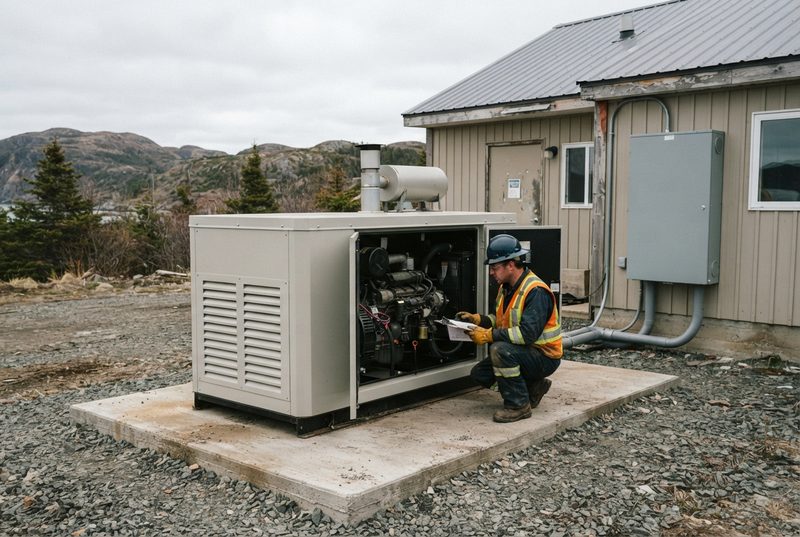
Grand Falls-Windsor sits further inland than most Newfoundland towns of its size, and that position changes its weather in a way that matters for electrical planning. Without the ocean nearby to moderate temperatures the way it does in St. John's or Corner Brook, Grand Falls-Windsor gets colder winter lows than either coastal city, even though the swings are still mild compared to truly continental parts of the country at the same latitude. For anyone sizing heating equipment, backup power or an outdoor electrical installation here, that inland cold is a real design factor, not a rounding error.
A mill town that became central Newfoundland's hub
The town grew up around hydroelectric power from the start. Early stations built on the Exploits River in the first decade of the 1900s supplied the Grand Falls pulp and paper mill and, from there, extended power out to surrounding towns including Windsor, Bishop's Falls and Botwood. More than a century later, Grand Falls-Windsor has grown into the largest town in central Newfoundland and the province's sixth largest, functioning as a hub for retail, health care, aquaculture and public services for a catchment that stretches across dozens of communities from the south coast to the northeast coast. Newfoundland Power maintains an area office in the town and serves it as part of the island-wide grid.
That regional hub role means the town's commercial and institutional buildings see more traffic and more reliance from surrounding communities than the town's own size would suggest. A retail plaza, medical clinic or public building in Grand Falls-Windsor is not just serving local residents, it is often the closest option for people travelling in from smaller communities an hour or more away.
What the colder inland climate changes
Heating loads matter more here than in coastal towns of similar size. A heat pump system installed in Grand Falls-Windsor needs to be sized with the town's colder winter lows in mind, and homeowners considering a heat pump conversion should have that conversation with an electrician before assuming a coastal specification will hold up locally. The same logic applies to standby generators: a generator sized for a mild coastal winter may not be adequate for the demand a Grand Falls-Windsor household places on it during an extended cold snap and outage at the same time.
The town's role as a catchment hub also means more underground and site electrical work than a town of similar size would typically see, since new retail, health and public buildings serving that wider region keep getting added on the edges of town. Coordinating that underground work with civil contractors early avoids the kind of rework that shows up when electrical and site grading are planned separately.
Where this shows up for different owners
Commercial and institutional property managers serving a wide catchment area should treat backup power as protecting more than their own building's operations, since a service interruption here can affect people who have travelled a considerable distance to reach that clinic, store or office. Our emergency service work covers backup power sized to the actual critical load of a commercial building.
Homeowners upgrading to a heat pump or adding electric heating capacity should have their panel and service assessed with the town's colder winter temperatures factored into the sizing, not a generic provincial average. Low and high voltage planning matters more here than in milder parts of the island, particularly for larger commercial or institutional loads.
Builders and general contractors working on new commercial or residential projects in the region should plan electrical scopes that account for the extra heating demand inland communities carry compared to the coast. A turnkey electrical scope that folds heating, lighting and backup power into one coordinated plan avoids discovering a sizing gap after the building is closed in. For new sites on the edge of town, underground infrastructure work coordinated with civil contractors from the start keeps the project on schedule.
Grand Falls-Windsor's role as central Newfoundland's hub means its electrical infrastructure carries weight beyond the town's own footprint, and that is worth keeping in mind for any project here, commercial or residential.
Talk to Puffin Power
Puffin Power serves Grand Falls-Windsor and the surrounding central Newfoundland region from its base in Conception Bay South. Contact us or call (709) 769-9713 to talk through a project.
Published 2026-09-23 · About 3 minute read