
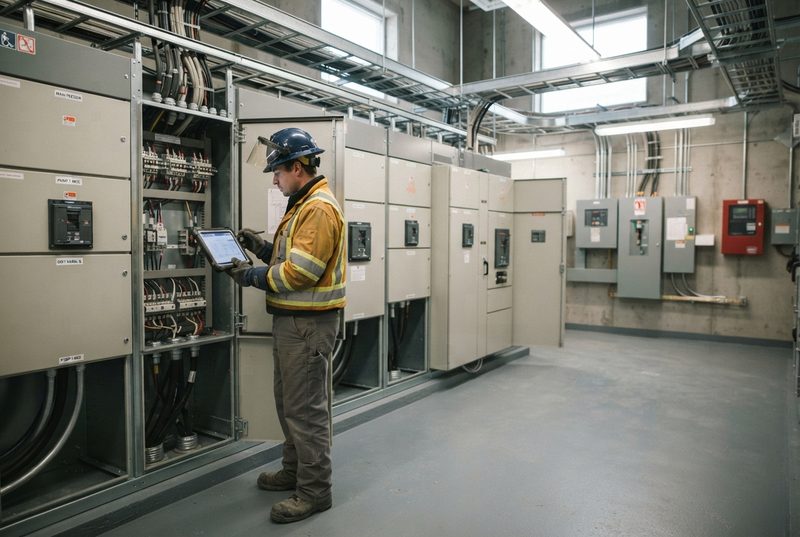
Building owners who have had an electrical safety study done, or who bought a building that already had one, are often left looking at yellow and orange labels on their panels and switchgear without a clear sense of what they mean or what is expected of them as the owner. The short version: those labels exist to tell anyone opening that equipment what hazard they are facing, and the owner has an ongoing responsibility to keep them accurate.
What an arc flash is
An arc flash is a sudden release of energy from an electrical fault, distinct from electric shock. It can cause serious burns and injury to anyone standing near the equipment when it happens, even without direct contact. Because the risk varies by equipment and by the electrical system feeding it, the hazard has to be calculated for each piece of equipment individually rather than assumed.
What the label tells you
An arc flash label typically identifies the level of hazard at that specific piece of equipment and the personal protective equipment required before anyone works on it while it is energized. In Canada, this labeling and the underlying hazard analysis are addressed by CSA Z462, the workplace electrical safety standard. The label is a summary of a more detailed engineering study, not a standalone document.
Who the label is for
The label is aimed at anyone who might open that panel or switchgear while it is live: your own maintenance staff, contractors, and electricians called in for service work. It is not primarily for building occupants or tenants, who should never be opening electrical equipment regardless of labeling.
The owner's ongoing responsibility
An arc flash study reflects the electrical system as it existed at the time of the study. If the building's electrical distribution changes, a service upgrade, added equipment, a reconfigured panel, the study and the labels can become inaccurate. Owners are responsible for keeping this current, which means the study should be revisited when the system changes meaningfully, not treated as a one-time purchase.
What to do if you inherited unlabeled equipment
If you bought or took over a building and cannot find documentation for an arc flash study, treat this as an open item rather than assuming the equipment is safe as is. An electrical contractor can assess whether a study exists, is current, or needs to be commissioned.
How often a study needs to be revisited
There is no single fixed interval that fits every building, since the right timing depends on how often the electrical distribution actually changes. A building with a stable electrical system may go longer between reviews than one that is regularly adding equipment or reconfiguring panels. Rather than picking an arbitrary schedule, treat any meaningful change to the distribution system as the trigger, and have a qualified provider confirm whether the existing study still applies or needs to be updated.
What this means for hiring contractors
Any contractor working on your energized electrical equipment should already understand arc flash hazard levels and show up with the PPE the labels call for. If a contractor is unfamiliar with the labels on your equipment or is not asking about the hazard study, that is worth raising before they start work.
Where this fits into building electrical maintenance
Arc flash labeling sits alongside other commercial building electrical maintenance items, insurance documentation, panel inspections, and preventive maintenance schedules, as part of keeping the building's electrical systems documented and safe to work on. Larger or more complex distribution systems benefit from a low and high voltage review as part of this process.
Puffin Power supports commercial building owners across Atlantic Canada with electrical assessments and emergency service work on existing systems, including equipment that needs a current arc flash study.
Talk to Puffin Power
If you are unsure whether your building's arc flash labels are current, or you have equipment with no labels at all, contact Puffin Power or call (709) 769-9713 to discuss next steps.
Published 2026-09-23 · About 3 minute read