
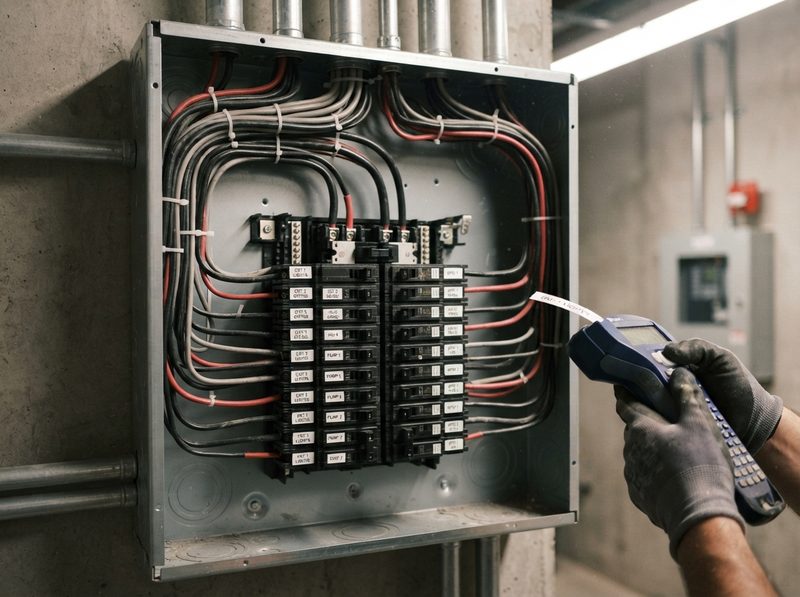
Building owners usually think about their electrical records only when someone asks for them: an insurer during a policy review, an inspector during a routine visit, or a buyer's due diligence team before a sale. Waiting until that request arrives to start assembling records is the wrong time to discover they do not exist.
What insurers and inspectors actually ask for
Insurers reviewing a commercial property's electrical risk, and inspectors verifying code compliance, tend to ask for similar categories of documentation:
- As-built electrical drawings showing the current distribution, not the original design if it has since changed.
- Permit and inspection records for past electrical work.
- Maintenance records, including panel inspections, thermal imaging, and any emergency lighting or life safety system testing.
- Arc flash hazard study documentation, where applicable.
- Records of any past electrical incidents, repairs, or upgrades.
Why gaps in records matter
An insurer who cannot verify a building's electrical maintenance history may treat it as higher risk, regardless of the equipment's actual condition, simply because there is nothing to review. An inspector who finds electrical work with no permit on file has to treat it as unverified, which can trigger a more invasive inspection than if the paperwork existed. In both cases, the absence of records creates a problem that good maintenance would not have caused on its own.
Building a record system that actually gets used
The building owners with usable records are not necessarily the ones who spend the most on maintenance. They are the ones who keep a simple, consistent system:
- A single location, physical or digital, for all electrical permits, inspection reports and drawings.
- A standing log for recurring items: panel inspections, emergency lighting tests, arc flash study dates.
- Updated as-built drawings after any electrical project, not just the original construction drawings.
- Contractor invoices and scope descriptions kept with the corresponding permit, so the two can be matched later.
What to do with historical gaps
Most buildings that have changed ownership or management have some gap in their electrical records. Rather than trying to reconstruct history that cannot be verified, focus on documenting the building's current condition: a fresh electrical assessment establishes a baseline going forward, even if it cannot answer questions about work done decades ago.
Who should hold the records
Relying on a single person's memory or a single contractor's files is a common way records quietly disappear, particularly when a property changes management companies or a long-serving maintenance contractor retires. The building owner, not any one contractor or manager, should be the one holding the master set of records, even if a contractor maintains their own copy for their own purposes. This way, a change in who does the work does not also mean a change in what the owner can produce on request.
Digital records still need a system
Scanning paperwork into a shared drive is a start, but it only helps if the files are organized in a way someone unfamiliar with the building can navigate. A folder structure by year, or by system, with a simple index describing what is where, is more useful than a single folder of hundreds of unsorted scans. Whoever manages the building day to day should know where this lives and be able to produce it without needing to track down a previous manager.
Before a sale or refinancing
Electrical records come up specifically during commercial real estate transactions. A seller with organized records moves through due diligence with fewer surprises. A buyer without them should budget for an independent electrical assessment rather than relying on the seller's account of the building's condition.
Where this fits with other maintenance
Good electrical records are the byproduct of routine maintenance done consistently: panel inspections, emergency service call logs, and preventive maintenance schedules. Owners who treat record keeping as a separate task from the maintenance itself tend to fall behind on both.
Puffin Power documents the work it performs for commercial clients across Atlantic Canada, including permits, as-built updates and inspection reports, as part of standard turnkey electrical practice.
Talk to Puffin Power
If you need an electrical assessment to establish a documented baseline for insurance or a pending inspection, contact Puffin Power or call (709) 769-9713.
Published 2026-09-23 · About 3 minute read