
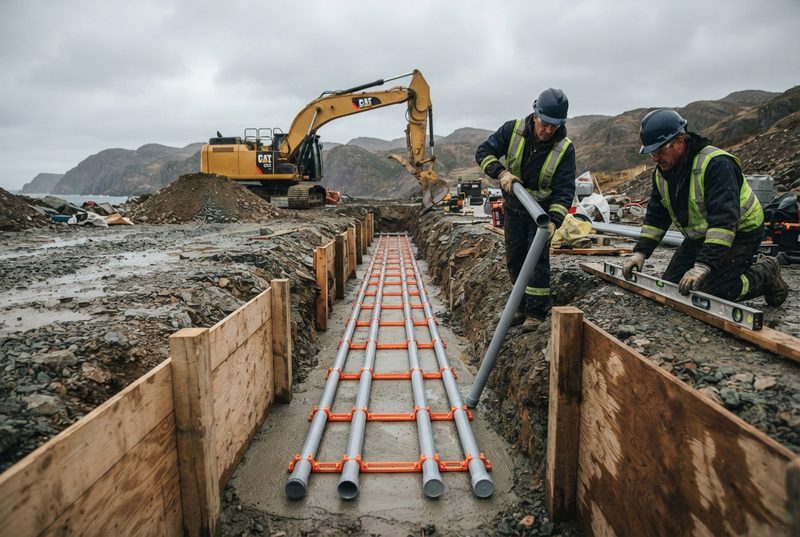
If you are planning a new build, underground electrical work has to be sequenced with civil scope from the start. Coordinate late, and the result is a trench cut through finished pavement or a schedule waiting on grading that was never lined up with electrical needs.
Why this coordination matters
Underground electrical work, service duct banks, site lighting feeders, transformer pads, has to go in before paving and landscaping close the site up. Either it is planned together with civil work from the outset, or it costs more once the site is finished and has to be reopened.
Duct banks and site utilities
Electrical duct banks often share a corridor with other underground utilities: water, sewer, gas, communications. Confirm routing and depth for each before excavation starts, so conflicts are found on paper rather than in an open trench. Our underground infrastructure work is usually planned alongside the civil engineer's utility drawings for exactly this reason.
Sequencing with grading and paving
Rough grading needs to be far enough along that duct bank elevations and depths are confirmed, but underground electrical work needs to happen before final grading and paving close the site. Getting this sequence wrong in either direction means added cost: either regrading around installed conduit, or cutting through finished surfaces to add it later.
Depth, frost and rock
Frost depth and bedrock affect how deep a duct bank can practically go and what excavation method the site requires. On rocky sites, this can mean a different trenching approach or additional cost that should be identified during design, not discovered once excavation equipment is on site and the schedule is already running.
Coordinating with other underground trades
Site lighting, EV charging infrastructure and transformer pads all typically require coordination with the general contractor's civil scope. The earlier the electrical contractor and the civil contractor share drawings and confirm crossing points, the fewer surprises show up once trenches are open.
Seasonal timing
In Atlantic Canada, frozen ground and winter weather can shut down excavation work for months at a time. If underground electrical scope is scheduled for late in a project that started in spring, check whether that timing pushes the trenching into a season when the ground is difficult or impossible to open. Sequencing underground work earlier in the schedule, even if it means other trades wait, can avoid losing an entire season to weather.
Site meetings and open questions
Regular site meetings that include both the civil contractor and the electrical contractor catch coordination problems while they are still easy to fix. A duct bank routing conflict found on a drawing costs nothing to resolve. The same conflict found after a trench is dug costs a re-excavation. Keep both trades talking through the site logistics plan, not just their own individual schedules.
Getting it on paper early
A simple underground utility coordination drawing, showing electrical, water, sewer, gas and communications together, resolves most conflicts before they become field problems. This does not need to be elaborate. It needs to exist before excavation starts, not after.
Rock and blasting considerations
Some sites in Atlantic Canada have shallow bedrock that requires blasting or rock hammering to reach the depth needed for a duct bank. If a geotechnical report or test pits show rock near the surface along the planned electrical route, flag it before pricing and scheduling are finalized. Rock excavation takes longer and costs more than trenching through soil, and it is far better to know this during design than to discover it once a trenching crew hits rock in the field.
A shared schedule, not two separate ones
The projects that avoid the worst coordination problems tend to be the ones where civil and electrical work sit on a single shared schedule, reviewed together, rather than two schedules that each assume the other trade will be ready when needed. It takes little extra effort to build one schedule together at the outset, and it removes most of the guesswork about who is waiting on whom.
Talk to Puffin Power
If you are planning underground electrical scope for a new build and want it coordinated with civil work from the outset, contact Puffin Power or call (709) 769-9713. We work this coordination into our design-build projects from the start.
Published 2026-09-23 · About 3 minute read