
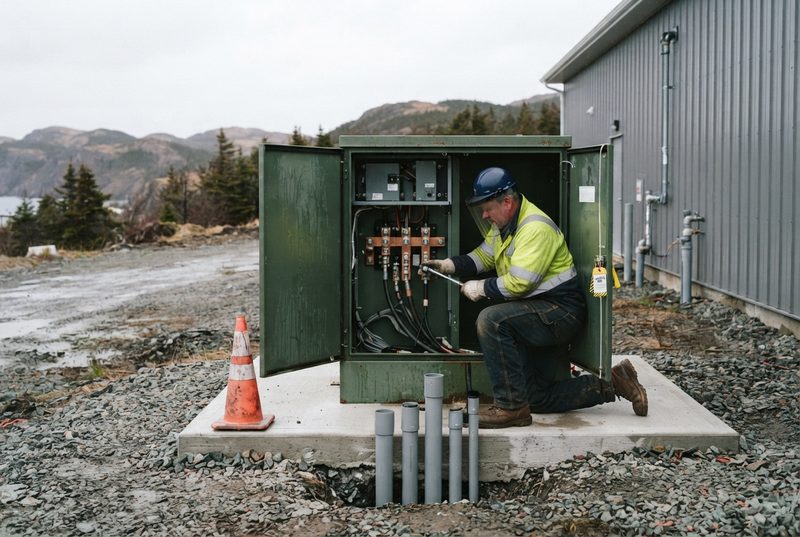
A general contractor needs the electrical permit in hand before rough-in, and needs to know who will inspect the work and authorize the connection. In Newfoundland and Labrador the answer depends on the address, and an incomplete application costs schedule at both ends of the job: a late start on rough-in and a late energization at the end. Details were checked on 19 October 2026. Confirm fees and forms before you budget.
Which authority issues your permit
Inside the City of St. John's, the City issues the electrical permit and inspects. Everywhere else in the province, Government Services does, through its Government Service Centre offices. Newfoundland Power's Service and Metering Guide names the same two authorities.
A site next to St. John's is not necessarily under the City. Mount Pearl's inspection services page says electrical work in the city needs an electrical permit from the province, while the City of Mount Pearl handles the building permit. That page names Service NL as the issuer; the provincial electrical pages are now headed Government Services.
The City of St. John's and the province both issue the permit to an electrical contractor, not to the owner or the general contractor. Confirm early which authority covers your site and that your contractor is licensed or registered with it. The City licenses contractors itself and publishes its list, and the province publishes a list of registered contractors. Both now enforce the 2024 Canadian Electrical Code: the City for permit applications on or after 1 August 2024, the province for permits issued on or after 1 July 2024.
Permits inside the City of St. John's
The permit has to be in hand before work begins. For commercial work the fee is tiered on construction value, starting at $242 for work of $2,000 or less. Above $2,000, the City wants estimates signed by the contractor, showing the breakdown of construction value without HST. Its fee schedule also lists a $242 renewal for an expired commercial electrical permit, so ask how long the permit runs on a long job.
Temporary construction power needs its own permit. The City's March 2026 bulletin says it can be issued for a construction site with an approved building application, and that all temporary power supplying a building must be removed before permanent service is approved. A temporary cut-over period may be allowed on request, at the discretion of the City and the utility.
Provincial permits everywhere else
Government Services requires approval before electrical equipment is installed or repaired. That covers wiring in residential, public and commercial or industrial buildings, and generators, transformers, switchboards and large storage batteries. A commercial application needs the completed form, detailed electrical plans and the fee. Registered contractors can apply through the online portal, which has separate options for new commercial permits and extensions.
Two provincial details matter on a longer job:
- Under the Electrical Regulations a permit may run 12 months from issue, and a copy must be posted on site until the work is done. The Fees Policy lists an extension at $60 plus HST, so diary the expiry if the electrical work will run past a year.
- The commercial fee is based on the total cost of the electrical work, with a $60 minimum.
What the application has to show
Give your electrical contractor what drawings alone do not supply.
The City revised its application in November 2025 to address frequent errors and omissions that had caused delays and rework, and has accepted only the revised form since 15 November 2025. It asks for:
- each type of work identified, such as a mini split and an EV charger on one project, with separate applications for different occupancies or building applications;
- the building application number, which comes from you or the owner;
- the City contractor licence number, plus the trade name if it differs;
- total cost of labour and material, with supporting documents for commercial work of $2,000 or more;
- a detailed description of the work, which appears on the electrical certificate, and work not listed may need a new permit;
- owner details matching the City's Assessment Roll, signed by the owner or a company director.
Incomplete or inaccurate submissions need a full resubmission.
For provincial permits, the department's electrical plans bulletin lists the minimum content for plans other than engineered stamped ones: occupancy and scope, a marked floor plan, service and branch circuit details, panel schedules with load calculations, a project load summary, breaker ratings, voltage, a symbol key, device information, and grounding and bonding. Plans that fall short may cause permits or connections to be withheld. The bulletin is dated 2011 but is still listed on the department's bulletin page. The form also asks whether other approvals are in place, such as fire and life safety and building accessibility, and the regulations let the chief inspector hold a permit or connection until other legislation is satisfied.
If your drawings may need an engineer's seal, read when electrical drawings need an engineer's stamp. A complete package helps the same way: see what an electrical estimator needs in a bid package.
Inspections during the job
In St. John's, inspections may occur at multiple stages depending on the project. Ask the inspector which stages apply to yours and put them in the schedule. For a scheduled disconnect and reconnect, the City says to request the inspection once the date is confirmed with the utility, since it may not accommodate a same-day request. After-hours inspections may be available for commercial and industrial properties at the contractor's cost.
On provincially permitted work, a bulletin dated 2 September 2026 says that, except for trenches under a utility's jurisdiction, electrical trenches must be inspected by a provincial inspector before backfilling. The contractor requests the inspection with its representative report, and photographs are not a substitute. The authority may require re-excavation if a trench was covered first. Put that in your civil sequence: no backfill until the electrical contractor holds the approval.
Service inspection and connection authorization
Where Newfoundland Power supplies the site, its guide says it connects a new or upgraded service only once an electrical permit has been obtained and it has received authorization to connect from the authority having jurisdiction. The authorization is the last paper in the chain, so give it an owner on your schedule.
Provincially, the Government Service Centre issues connection authorizations and certificates of inspection on behalf of the Chief Electrical Inspector, after the registered contractor submits its representative inspection report. In St. John's, since 1 January 2026 all utility-supplied equipment, including conductors and current transformers, must be installed before the service inspection. Otherwise the City issues a deficiency notice and may charge a premature inspection fee, and deficiencies must be corrected before service authorization.
Questions to ask before rough-in
The application is in your team's hands. Inspections and the connection also depend on an inspector's and the utility's calendars. Before rough-in, ask your electrical contractor:
- Is the application complete, including the building application number and owner signature?
- Are detailed plans attached, with load calculations and schedules?
- Are fire and life safety, accessibility and other approvals in place?
- Who calls the utility for utility-supplied equipment?
- When will each inspection be requested, and what must stay uncovered until then?
- Who removes temporary power, and when?
Talk to Puffin Power
Puffin Power is licensed as an electrical contractor in Newfoundland and Labrador (certificate CA-190306) and works across the Avalon and Conception Bay. For projects outside St. John's, send the drawings and location through our contact page and we will price the work with the provincial permit and inspection in our scope. If the site is inside St. John's, say so, because the City licenses contractors separately and who holds the permit there should be settled before award. The scope of our turnkey electrical service lists permit drawings and utility applications. For local conditions, see our St. John's and Mount Pearl area pages and electrical work in St. John's.
Published 2026-10-19 · About 6 minute read