
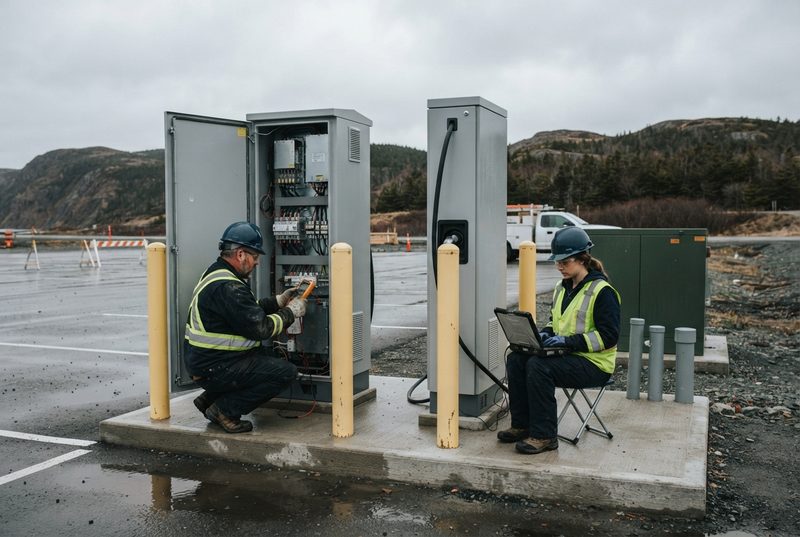
Business owners adding EV charging, whether for customers, employees or a fleet, face an early decision: Level 2 or DC fast charging. The right answer depends less on preference and more on how long vehicles are actually parked at your location.
What separates the two
Level 2 charging runs on 240 or 208 volt power and delivers a moderate charging rate, adding a meaningful amount of range over a few hours. It is the right fit anywhere a vehicle sits for a while, such as an employee parking lot, a hotel, a retail location with typical dwell times, or an apartment building.
DC fast charging delivers power directly as direct current at much higher rates, adding significant range in well under an hour. It suits locations where vehicles need to charge quickly and move on, such as highway corridors, quick-service retail, or fleet depots running vehicles on tight schedules.
Match the charger to the dwell time
The most common mistake is installing the wrong charger type for how people actually use the location.
- Employee parking, where vehicles sit for a full workday, rarely needs DC fast charging. Level 2 covers a full charge overnight or over a workday without the added cost.
- A retail or restaurant location where customers typically stay 20 to 40 minutes benefits more from DC fast charging, since Level 2 would add only a small amount of range in that window.
- A hotel, where guests park overnight, is well suited to Level 2.
- A quick-turnaround fleet depot, where vehicles need to be back on the road within an hour, generally needs DC fast charging.
Cost and infrastructure differences
DC fast chargers cost significantly more to purchase and install than Level 2 units, and they require considerably more electrical capacity. A DC fast charger installation often means new service, a transformer, or a dedicated feed from the utility, which involves underground infrastructure work and longer lead times than a Level 2 installation. Level 2 chargers are less demanding on the electrical system and can often be added to an existing commercial service with more modest upgrades. Before committing to DC fast charging, it is worth having an electrical contractor assess what your site's existing service can support and what a new feed would require.
Multiple chargers change the math
Installing several chargers of either type raises a load management question. If every charger draws its full rated power at once, the site's total demand can be far higher than what is typically used, since not every vehicle charges simultaneously at full power. Load management systems allow a site to install more charging capacity without over-building the electrical service, by managing how power is distributed across chargers as demand changes throughout the day.
Site planning questions to answer early
- How long do vehicles actually stay at this location, on average and at peak times?
- What does the existing electrical service support, and what would a fast charging installation require from the utility?
- Is this charging for the public, for employees, or for a fleet, since the answer affects both charger type and access control?
- Will demand grow enough in the next few years to plan for expansion now rather than digging up the site again later?
Getting the electrical side right
Whichever charger type fits your site, the underlying electrical work, service capacity, underground runs, panel space and load management, needs to be planned before equipment is ordered. A charger manufacturer can tell you what their unit needs. An electrical contractor familiar with commercial sites can tell you what your property can actually deliver.
A mix is often the right answer
Larger sites do not always have to choose one charger type exclusively. A shopping centre might install a small bank of DC fast chargers near the entrance for quick customer visits, alongside Level 2 chargers in an employee or long-stay section of the lot. Deciding this mix upfront, rather than defaulting to whichever charger type is currently popular, keeps the electrical design matched to how the site is actually used.
Talk to Puffin Power
Puffin Power designs and installs commercial EV charging for businesses across Atlantic Canada, from site assessment through installation. Contact us to discuss your site, or see our EV charging services and underground infrastructure work.
Published 2026-09-23 · About 3 minute read