
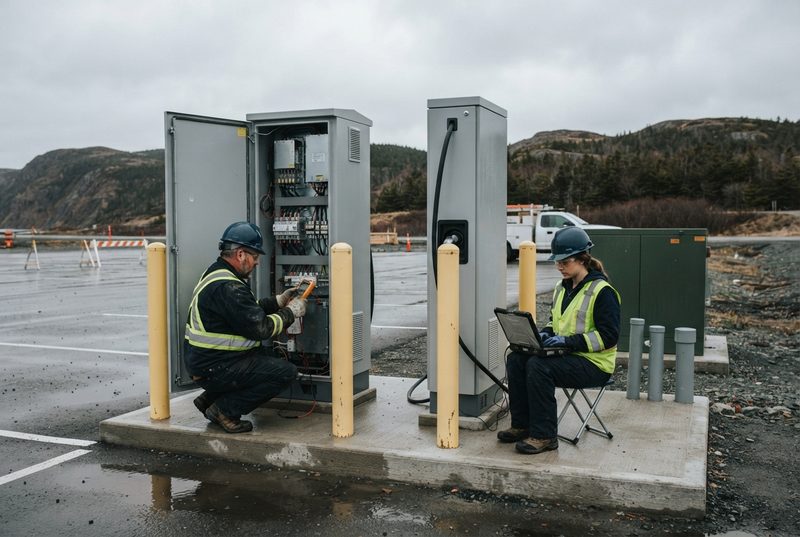
Fleet operators adding electric vehicles, whether a handful of vans or a larger delivery or service fleet, face an electrical planning problem that looks nothing like installing a single home charger. Getting it right means starting from how the fleet actually operates, not from how many chargers seem like a reasonable number.
Start with the operating pattern
Before any electrical planning, map out how vehicles are actually used: routes, typical daily mileage, return times, and how much downtime each vehicle has at the depot between shifts. A fleet where every vehicle returns by early evening and does not go back out until morning has a wide overnight charging window and can generally rely on Level 2 charging. A fleet running vehicles in shifts, where a vehicle needs to be back on the road within an hour or two of returning, needs faster charging and a different electrical design entirely.
Sizing the electrical service
Fleet depots often need considerably more electrical capacity than the building's existing service provides, especially older facilities not built with vehicle charging in mind. This can mean a new service, additional transformer capacity from the utility, and underground infrastructure work to bring power to where vehicles actually park. This is not a project to start by ordering chargers. It starts with an electrical assessment of the site's existing service and what a fleet charging installation would require from the utility, since utility-side upgrades often have the longest lead times in the whole project.
Load management is not optional at fleet scale
With enough vehicles charging on a shared service, a load management system that distributes available power across chargers as demand changes is close to essential. Without it, a depot either needs to size its electrical service for every vehicle charging at full power simultaneously, which is expensive and often unnecessary, or risks tripping capacity limits during peak return times. Planning load management alongside the charger count and site layout avoids both problems.
Phasing makes sense for most fleets
Few fleet operators convert every vehicle to electric at once. A phased approach, converting a portion of the fleet on a set schedule, lets the electrical infrastructure be built to match. The mistake to avoid is installing conduit and capacity for only the first phase, then having to dig up the site again for phase two. Whenever possible, install the underlying infrastructure, conduit runs and panel capacity, for the fleet's expected end state, even if chargers themselves are added in stages.
Questions to bring to an electrical contractor
- What does the depot's current electrical service support, and what would a full fleet conversion require.
- What is the realistic charging window for the fleet's operating pattern, and does it call for Level 2, DC fast charging, or a mix.
- Is a phased rollout planned, and if so, should infrastructure be built for the full plan now.
- What underground or utility-side work is needed, and what is the lead time for that work, since it is often the longest pole in the schedule.
- Are there fleet-specific funding programs worth checking, including federal programs that have supported charging infrastructure for fleets, with current eligibility confirmed directly with the funding agency.
Coordinate early, not after equipment is ordered
Fleet EV charging projects tend to go wrong when vehicle procurement and electrical infrastructure are planned on separate tracks that meet only at the end. Bringing an electrical contractor into the conversation while the fleet conversion plan is still being drafted means the electrical timeline, which usually takes longer than expected because of utility coordination, does not become the bottleneck holding up vehicles that have already arrived.
Talk to Puffin Power
Puffin Power plans and installs EV charging infrastructure for fleet depots across Atlantic Canada, from utility coordination through load management design. Contact us to start a site assessment, or see our EV charging services and underground infrastructure work.
Published 2026-09-23 · About 3 minute read