
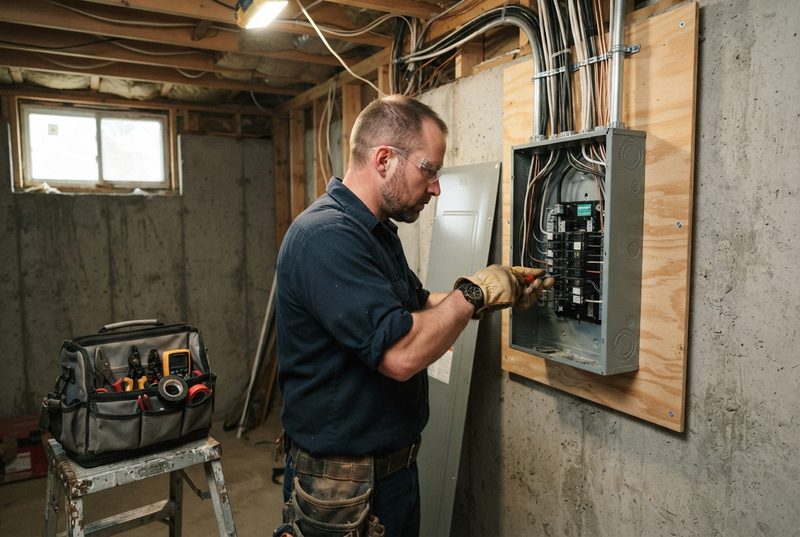
Homeowners considering an electrical service upgrade are usually prompted by something specific: an EV charger, a heat pump, an addition, or a panel that is already full with no room for a new circuit. Knowing what actually pushes a home from 100 amp to 200 amp service helps separate a real need from a precaution that can wait.
What the amperage rating actually means
A home's electrical service is rated for the maximum current it can safely deliver, not the amount it uses at any given moment. A 100 amp service was standard for smaller homes for a long time and can be entirely adequate for a home with modest electrical demand. The rating becomes a constraint when the home's actual and planned electrical load starts to approach or exceed it.
Signs a 100 amp service is no longer enough
- The panel has no open breaker spaces left for a new circuit.
- Adding a heat pump, an EV charger, or an electric range would require load calculations that push close to the service limit.
- Breakers trip under normal combined use, not a fault, when multiple larger appliances run at once.
- The home was built with an electric furnace or baseboard heat plus other significant loads already close to capacity.
What a load calculation actually checks
An electrician sizing a service upgrade does not simply add up the rating of every breaker in the panel, since not everything runs at once or at full capacity. A proper load calculation accounts for the home's actual and planned equipment, applies standard demand factors, and determines whether 100 amp, 200 amp, or something else is the right target, sized for the home's realistic future use, not just its current state.
What the upgrade involves
A service upgrade typically replaces the meter base, the main panel, and the service conductors from the utility connection, and often requires coordination with the utility to disconnect and reconnect service. This is not a same-day swap: expect it to require a permit, an inspection, and a scheduled outage while the work happens.
Planning for what comes next, not just today
If a homeowner is upgrading service anyway, it is worth sizing the new panel with some room for future additions: an EV charger not yet installed, a heat pump conversion being considered, a future addition. If you are already planning a larger renovation, coordinate the service upgrade with your design-build plans rather than as an isolated afterthought. Undersizing a new panel to match only today's needs is a common reason homeowners end up doing this work twice within a decade.
Permits and inspection
A service upgrade requires a permit and inspection through your provincial electrical inspection authority. This is not optional and not something to skip because the work seems straightforward. An unpermitted service upgrade can create problems later with insurance or with a home sale, when a buyer's inspector asks for documentation that does not exist.
Temporary power during the changeover
Because a service upgrade requires disconnecting and reconnecting the utility connection, the home will be without power for some portion of the work. Ask your electrician how long this outage is expected to run and whether it can be scheduled for a time of day or a season that minimizes disruption, particularly if the home relies on well water, a sump pump, or medical equipment that needs continuous power.
What to ask an electrician before upgrading
- What load calculation supports the recommended service size, and does it account for planned future additions.
- What is included in the quoted price: meter base, panel, conductors, permit, and any utility coordination fees.
- How long will the home be without power during the changeover, and can it be scheduled around the homeowner's needs.
Puffin Power performs residential service upgrades across Atlantic Canada, sizing new panels around both current and reasonably anticipated future loads.
Talk to Puffin Power
If your panel is full or you are planning an addition that will need more capacity, contact Puffin Power for a load assessment, or call (709) 769-9713.
Published 2026-09-23 · About 3 minute read