
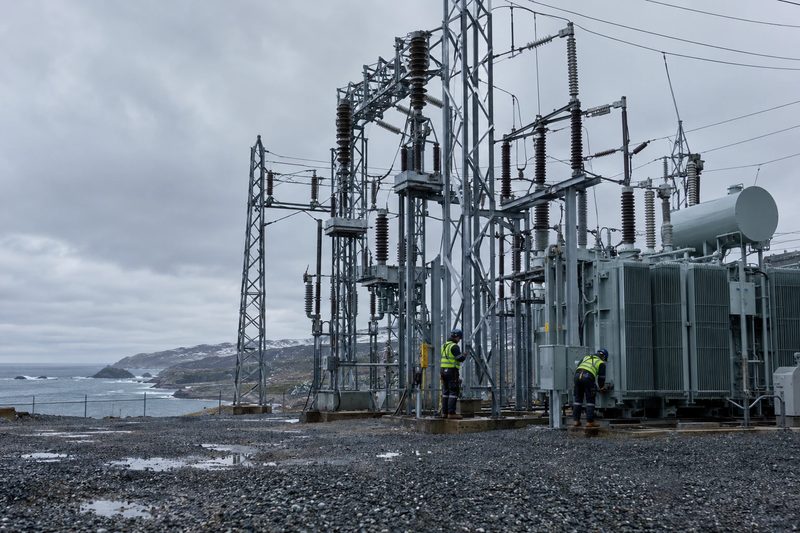
If your project involves higher-voltage service, a large commercial development, or land near existing utility infrastructure, the word substation is going to come up. It is worth understanding what one actually does, since it affects how a project connects to power and what capacity is realistically available.
The basic job of a substation
Electricity travels efficiently over long distances at high voltage, but almost nothing that uses electricity, from a house to most commercial equipment, can use it at that voltage directly. A substation is the facility that changes voltage levels and routes power between the transmission system, which moves electricity over distance, and the distribution system, which delivers it to homes and businesses.
At its core, a substation does a few things:
- Transforms voltage, stepping it down from transmission levels to distribution levels, or in some cases stepping it up.
- Switches and protects the system, isolating a section of the network automatically if a fault occurs, so a problem in one area does not take down a much larger area.
- Routes power to different distribution circuits feeding different neighbourhoods or facilities.
- Monitors the system, giving the utility visibility into loads, faults and equipment condition across its network.
Why this matters for a development project
The substation nearest your site, and how much capacity it has left to give, often determines how straightforward or complicated your electrical service connection will be. A site near a substation with available capacity might connect with relatively standard work. A site that would push a local substation past its limits may require the utility to upgrade equipment before your project can get the service it needs, which affects both cost and timeline.
This is one of the first things worth understanding early in a project, particularly for anything larger than a typical commercial building: a warehouse, an industrial site, a multi-unit residential development, or anything with heavy electrical loads like EV charging infrastructure at scale.
What developers should ask early
- What substation serves this site, and is there known available capacity.
- Is a service upgrade or new equipment required to support the project's load, and who is responsible for that cost.
- What is the realistic timeline for any utility-side work, since this can run longer than the construction schedule itself.
- Does the project's phasing allow for load to come online gradually, which can sometimes avoid triggering a larger capacity upgrade.
These questions belong in the design-build process from the start, not after drawings are finished, since the answers can affect site layout, equipment selection and where underground infrastructure needs to run.
Substations and reliability
Substation equipment, including transformers, breakers and protective relays, is also why a fault somewhere on the grid sometimes affects a wide area rather than a single building. Understanding that a substation-level event is out of any single property owner's control, and different from a fault inside your own building, helps set realistic expectations when a wider outage happens.
What happens during a substation outage
When a fault occurs at or near a substation, protective equipment is designed to isolate the smallest section of the network necessary to clear the problem, but depending on where the fault is, that can still mean an outage affecting a large area for a period of time while the utility investigates and restores service. This is different from a fault inside your building's own electrical system, which is something an electrical contractor can diagnose and fix directly. If an outage affects a wide area and multiple neighbouring properties, that is a strong sign the cause sits upstream at the utility level, and the useful move is reporting it to your utility's outage line rather than calling an electrician to look at equipment that is not the source of the problem.
Talk to Puffin Power
If your project involves connecting to the utility grid at higher voltage or needs low or high voltage work coordinated with utility infrastructure, Puffin Power can help plan that connection early. Call (709) 769-9713 or reach out through /contact.html.
Published 2026-09-23 · About 3 minute read