
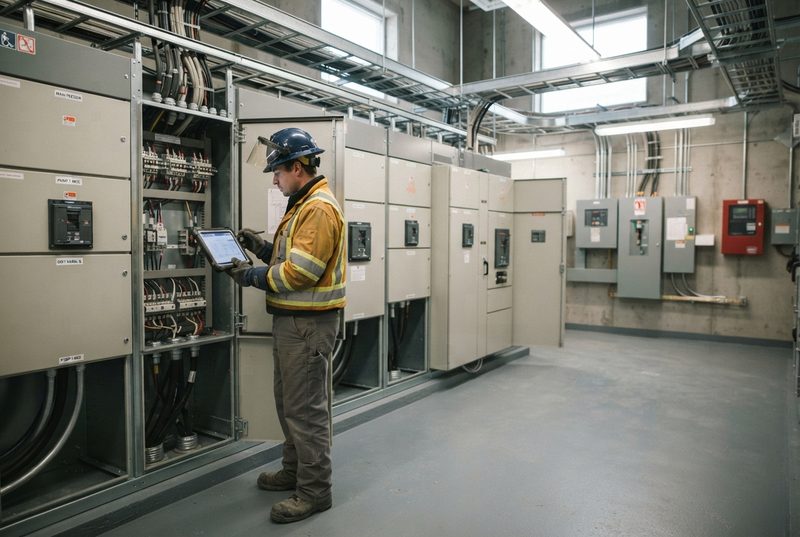
If you are setting up a new commercial project, the delivery method you choose for the electrical scope affects cost certainty, schedule and who is accountable when something does not go as planned. Understanding the difference before design starts, rather than after, keeps the choice deliberate instead of default.
What each method is
Design-bid-build separates design and construction into two contracts: an engineer completes drawings, the project goes to tender, and a contractor builds to those drawings. Design-build puts design and construction under one contract, with the design-builder responsible for both the drawings and the finished work, usually through a partner engineer for stamped drawings.
Where design-bid-build works well
This method suits projects where the owner wants a fully engineered scope defined before committing to a price, and where a public tender process is required. It gives clear documentation for comparing bids against each other. The tradeoff is that any gap or error in the drawings becomes a change order during construction, since the contractor built exactly what was drawn.
Where design-build works well
Design-build suits projects where schedule matters, where the electrical scope has open questions such as service size, generator sizing or equipment selection, or where the owner wants one point of accountability instead of coordinating between a separate designer and contractor. Electrical issues tend to get caught and resolved during design, before they become field problems.
Cost certainty and change orders
Design-bid-build gives cost certainty at award, based on completed drawings, but exposes the owner to change orders for anything the drawings missed. Design-build carries more early estimating and less certainty until the design is far enough along to price firmly, but tends to produce fewer downstream change orders because the team pricing the work is also the team drawing it.
Coordination and long-lead equipment
Long-lead electrical equipment, switchgear, transformers and standby generators, benefits from early ordering. Design-build allows equipment selection and ordering through our turnkey electrical process to start well before drawings are fully finished, which can protect a schedule. In design-bid-build, equipment cannot usually be ordered until the design is complete and a contractor is under contract, which stretches the timeline.
Risk allocation
The two methods put risk in different places. In design-bid-build, the engineer carries the risk of a complete and accurate design, and the contractor carries the risk of executing it as drawn, with disputes usually centering on whether a condition was reasonably discoverable from the drawings. In design-build, the design-builder carries both risks together, which simplifies who is accountable but means the owner is relying more heavily on that single team's judgment through the whole project.
Owner involvement during design
Design-bid-build gives an owner a complete, reviewable design to approve before construction pricing is committed. Design-build asks for more owner involvement earlier, since decisions about equipment, layout and system capacity happen alongside pricing rather than after a design is finished. Owners who want to be closely involved in early decisions sometimes prefer this. Owners who want to approve a finished design once and then step back often prefer the reverse.
Contracts and documentation
Whichever method is used, the contract should say plainly who owns responsibility for code compliance, who pays for a required stamped drawing, and how changes are priced. A design-build contract should describe the design development process and when pricing becomes firm, since that firming point is less obvious than the tender date in design-bid-build.
Making the call
Neither method is right for every project. A public institution with procurement rules may have no choice but design-bid-build. A commercial owner building on a schedule, or one who wants a single point of contact for the electrical scope from concept to commissioning, is often better served by design-build.
Talk to Puffin Power
If you are deciding how to structure the electrical portion of a project, contact us to talk through what design-build looks like on your timeline. Call (709) 769-9713 to discuss your project.
Published 2026-09-23 · About 3 minute read