
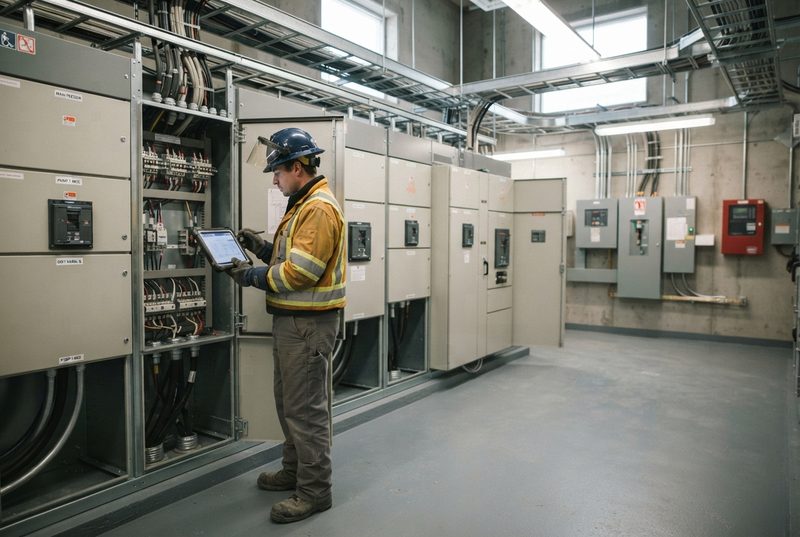
Commercial building owners looking at aging fluorescent or high-intensity discharge lighting are usually weighing two things: the cost of the retrofit against the ongoing cost of running and maintaining what is already installed. An LED retrofit is primarily an electrical project, not just a fixture swap, and treating it that way avoids problems after installation.
Why owners retrofit
Older fluorescent and HID fixtures draw more power, generate more heat, and need more frequent lamp and ballast replacement than LED equivalents. Reduced energy draw and reduced maintenance calls are the two most common reasons owners retrofit, along with better and more even light output in warehouses, parking structures and retail space.
What a retrofit actually involves
A straightforward retrofit replaces the lamp and driver inside an existing fixture housing. A more involved retrofit replaces the fixture entirely, which matters when the existing housing is damaged, outdated, or not compatible with an LED driver. Either approach can also be a chance to review the lighting layout itself. Some spaces were designed around the output pattern of older fixtures and can use fewer, better-placed LED fixtures to achieve the same or better coverage.
Circuits and controls
LED fixtures draw less current than what they replace, which is generally good news for existing circuits, but it is still worth having the circuits and panel checked rather than assumed. This is also a natural point to add or upgrade lighting controls: occupancy sensors, daylight sensors, or zoned switching. These controls only pay off if the underlying circuits and wiring support them, so this should be reviewed as part of the retrofit design, not added afterward.
Dimming and compatibility
Not every LED driver is compatible with every existing dimmer or control system. Mixing incompatible components leads to flicker, buzzing, or reduced fixture life. If the building has existing dimming or a building automation system tied into lighting, confirm compatibility with the specific LED products being installed before ordering in bulk.
Utility programs
Some utilities in Atlantic Canada offer incentive programs for commercial lighting upgrades. Availability, eligibility and program details change and vary by utility, so ask your utility directly rather than assuming a program exists or estimating a rebate amount before it is confirmed.
Sequencing the work
Retrofits in occupied commercial space usually happen in phases, floor by floor or area by area, to avoid taking a whole building dark at once. A contractor who has done this kind of phased work before will plan around your operating hours and tenant schedules rather than asking you to work around theirs.
Rebate timing and product selection
If a utility incentive program does apply, it usually specifies eligible product types or efficiency thresholds, and those requirements can change between program cycles. Confirm eligibility for the specific fixtures being proposed before finalizing a product order, rather than assuming a fixture qualifies because a similar one did on a past project. Program administrators can usually confirm this in writing, which is worth keeping with your project records in case the rebate is questioned later.
Warehouses and high-bay spaces
Warehouses, distribution centres and other high-bay commercial spaces are common retrofit candidates because older high-bay fixtures run hot, take time to restrike after a power interruption, and are expensive to access for maintenance. LED high-bay fixtures address the heat and restrike issues directly and are usually mounted at a similar height, which keeps the retrofit from requiring new structural mounting points. Confirm with your contractor that the proposed fixture's light output and beam pattern actually match the layout of the space, since a fixture that looks similar on paper can leave uneven coverage on the floor.
What to ask a contractor bidding the work
- Are they proposing a lamp-and-driver retrofit or full fixture replacement, and why.
- Will the new fixtures and any added controls work with existing circuits without additional panel work.
- What warranty applies to the fixtures and the labour, separately.
- How will work be sequenced to keep the building operating during the retrofit.
Puffin Power designs and installs LED retrofits for commercial buildings as part of turnkey electrical work, reviewing circuits and controls rather than treating a retrofit as a simple fixture swap. Read more about the company on the about page.
Talk to Puffin Power
If you are comparing quotes for an LED retrofit and want to understand what is actually involved before you commit, contact Puffin Power or call (709) 769-9713.
Published 2026-09-23 · About 3 minute read