
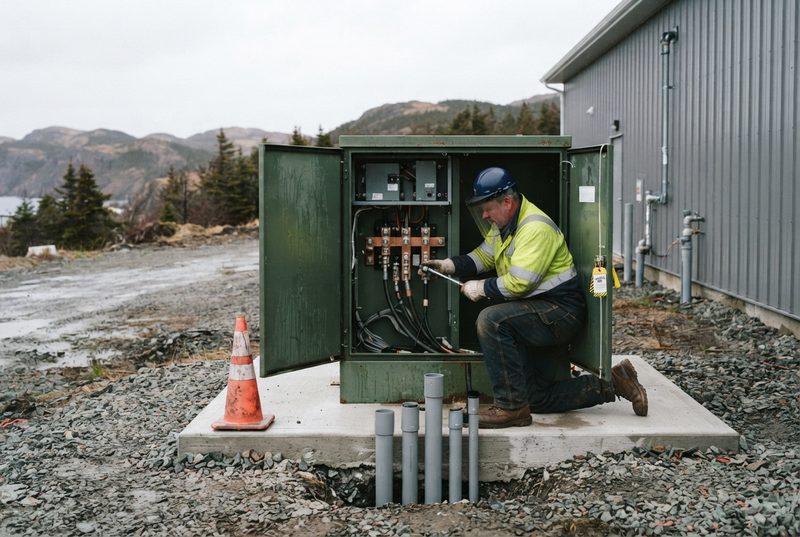
If you are scheduling a commercial project, the completion date is often set by equipment lead times rather than by labour or weather. Knowing what to check before the schedule is locked in avoids a surprise mid-project.
Why lead times matter
On many commercial projects, the completion date is no longer set by construction sequencing, it is set by when the switchgear or transformer arrives. Electrical equipment lead times have stretched well beyond what they once were, and a schedule built without checking current lead times can be wrong before construction even starts.
What tends to be long-lead
Medium voltage switchgear, service transformers, standby generators, automatic transfer switches and large distribution panels are the items most likely to hold up a schedule. Smaller devices, breakers, conduit and wire, are generally available faster, though even these can be affected by broader supply conditions at times.
Ordering before design is finished
Where the project delivery method allows it, order long-lead equipment as soon as the size and general specification are settled, even if finishing details of the design are still being worked out. This is one of the practical advantages of a design-build approach: equipment procurement can start before every drawing is complete, because the same team controls both design and ordering.
Utility-supplied equipment
Some equipment, particularly transformers and metering, may be supplied or approved by the local electrical utility rather than the contractor. Utility lead times and approval processes run on their own schedule, and applications should go in as early as the project allows. Confirm this with the utility directly rather than assuming their timeline matches the construction schedule.
Substitution risk
If a specified manufacturer has a lead time that threatens the schedule, ask about an equivalent product from another manufacturer early, not two weeks before the equipment is needed. A substitution reviewed and approved with time to spare is a normal part of procurement. The same substitution requested under schedule pressure invites mistakes.
Storage and site logistics
Ordering early solves the lead time problem but creates a new one: where does the equipment go if it arrives before the site is ready for it. Confirm delivery timing against site readiness, and if early delivery is unavoidable, arrange secure, weatherproof storage rather than leaving switchgear or a transformer sitting exposed on an unfinished site. Equipment damaged in storage before it is even installed defeats the purpose of ordering early.
Communicating lead times to the whole team
A long lead time on one piece of equipment affects more than the electrical schedule. It can shift when a mechanical room can be closed in, when other trades can complete work around the equipment location, and when commissioning can start. Share confirmed lead times with the general contractor and other trades as soon as they are known, rather than holding the information until it becomes urgent.
Building lead time into the schedule
Get current lead time quotes for major equipment before the schedule is finalized, not after. A schedule built on last year's lead times, or on an assumption that has not been checked, is a common reason a project misses its completion date for reasons that had nothing to do with labour or weather.
Insurance during the wait
Equipment on order or in transit for months represents real value sitting outside your control until it arrives. Confirm who carries insurance on it during manufacturing, shipping and any interim storage, and get this in writing before placing a large order. This is easy to overlook when the focus is on delivery dates, but it matters if equipment is lost or damaged before it ever reaches the site.
Talk to Puffin Power
If you want current lead times on switchgear, transformers or standby generators for a project you are scheduling, contact Puffin Power. Our low and high voltage team can help place orders early through a design-build arrangement.
Published 2026-09-23 · About 3 minute read