
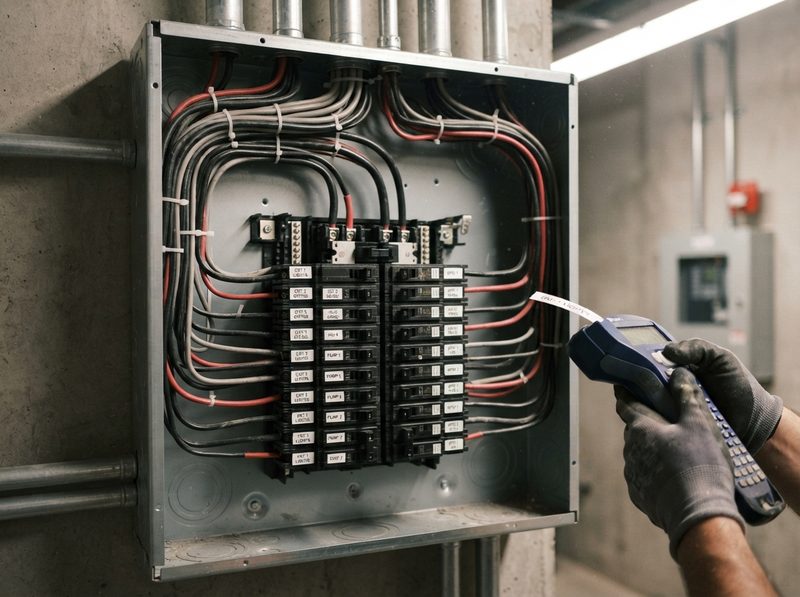
Property managers scheduling electrical work in an occupied building are managing a different problem than a contractor building on an empty lot: the building has to keep functioning while the work happens. Getting the sequencing and communication right is often more important to tenants than the work itself.
Start with what actually needs a shutdown
Not all electrical work requires cutting power to tenants. Work on a dedicated circuit, a specific piece of equipment, or an isolated area may not affect anyone else in the building. Ask your contractor early which parts of the project need a shutdown, which parts can happen with power live, and which parts fall somewhere in between, needing power off only briefly.
Timing shutdowns around tenant operations
For work that does require a shutdown, timing matters more than most other factors. A retail tenant cannot lose power during business hours. An office tenant may tolerate a shutdown over a weekend but not mid-week. A restaurant tenant has walk-in coolers and freezers that cannot go without power for long, regardless of the day. Ask each affected tenant directly rather than assuming a generic after-hours window works for everyone.
Notice periods
Give tenants real notice, not a same-week email, particularly for anything affecting refrigeration, security systems, or IT infrastructure. A reasonable notice period gives a tenant time to plan around the outage: moving perishable inventory, rescheduling appointments, or arranging backup power for anything critical.
Communicating scope, not just timing
Tenants generally care less about the technical scope of the work than about three things: when power will be off, how long it will be off, and what happens if something goes wrong and the work runs long. Give tenants a realistic window with some buffer built in, rather than the best-case estimate, so a minor delay does not turn into a communication problem on top of an electrical one.
Multi-tenant buildings and shared systems
In a multi-tenant building, some electrical work affects shared infrastructure, main services, common area panels, life safety systems, even when only one tenant's space is being renovated. Confirm with your contractor whether a project described as affecting one unit actually stays contained to that unit's circuits, or touches something shared.
Emergency and life safety systems
Work that touches fire alarm interfaces, emergency lighting, or exit signage needs particular care in an occupied building, since these systems cannot be left non-functional for an extended period while tenants are present. Confirm with your contractor how these systems will be maintained or temporarily substituted during the work.
When a tenant asks to reschedule
Even with advance notice, a tenant will sometimes ask for a shutdown to move because of their own scheduling conflict. Build some flexibility into the project schedule for this rather than treating the first proposed date as fixed, since an inflexible schedule tends to produce more friction with tenants than a short delay would. At the same time, be clear with tenants about how much flexibility actually exists, since work that depends on a utility outage window or a coordinated multi-trade shutdown may have far less room to move than a single tenant's internal electrical work.
After the work is done
Once a shutdown is complete, confirm with each affected tenant that their power, and anything sensitive to an outage, security systems, refrigeration, servers, came back up correctly before the crew leaves the site. A brief follow-up avoids a tenant discovering a problem hours later with no one left on site to address it, and it gives the property manager a clean record that the work was completed without issues.
Building the relationship with a contractor who understands this
A contractor experienced in occupied commercial buildings will ask about tenant schedules before proposing a timeline, rather than handing the property manager a schedule built around the crew's convenience. This is worth screening for when hiring, since the smoothest electrical projects in occupied buildings are the ones planned around the tenants from the start, not adjusted after complaints start coming in.
Puffin Power plans commercial electrical work around occupied buildings and tenant schedules across Atlantic Canada, as part of turnkey electrical project delivery, with emergency service available if something comes up mid-project.
Talk to Puffin Power
If you have electrical work coming up in an occupied building and want a contractor who will plan around your tenants, contact Puffin Power or call (709) 769-9713.
Published 2026-09-23 · About 3 minute read