
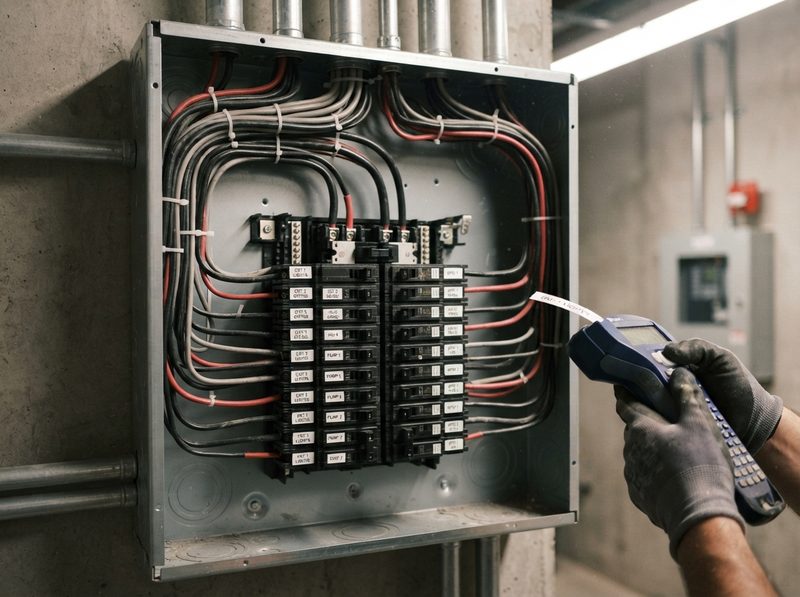
Commercial building owners often discover their electrical service is undersized only when they try to add something, a new tenant, new equipment, or an EV charger, and find there is no room left on the panel. Recognizing the warning signs earlier avoids a rushed, expensive upgrade later.
Breakers that trip under normal use
A breaker that trips occasionally under a legitimate load, not a fault, is the clearest sign the circuit or the service is carrying more than it comfortably should. If this happens with normal equipment running, it is worth having the load reviewed rather than just resetting the breaker and moving on.
No spare capacity in the panel
An electrical panel with no open breaker spaces cannot accept new circuits without either a subpanel or a service upgrade. This becomes a problem the moment a tenant, a piece of equipment, or a renovation needs a new circuit and there is nowhere to put it.
Dimming or flickering under load
Lights that dim noticeably when larger equipment starts up, an elevator, a compressor, a piece of HVAC equipment, point to a service or feeder working near its limit. This is different from the brief flicker every system shows occasionally. Consistent dimming tied to specific equipment starting is a load signal worth investigating.
Warm panels or breakers
A panel, breaker, or feeder conductor that feels warm to the touch, or shows discoloration, has been carrying more current than it should for some period of time. This is also a safety issue, not just a capacity one, and should be looked at promptly rather than scheduled for a future review.
Add-ons that keep getting deferred
If a building has postponed adding EV charging, additional HVAC capacity, or new tenant equipment because there is no room on the panel, that deferral is itself a sign the service needs a real evaluation rather than another workaround.
What a load assessment actually checks
An electrical contractor evaluating whether a service is undersized will typically look at:
- The building's actual measured demand versus the service's rated capacity.
- How much of that demand is from equipment that does not run continuously, since panels are sized for realistic combined load, not the sum of everything installed.
- Planned additions over the next several years, not just current use.
- Whether a subpanel or feeder upgrade solves the immediate problem, or whether the main service itself needs to increase.
Frequent nuisance calls to the electrician
A building that calls an electrician repeatedly for tripped breakers, flickering circuits, or equipment that will not start reliably is often treating symptoms of an undersized service one call at a time, rather than addressing the underlying capacity problem. If the same panel or feeder keeps coming up across multiple unrelated service calls, ask directly whether the pattern points to a capacity issue rather than a series of unrelated faults.
The cost of waiting
Postponing a needed service upgrade does not remove the underlying problem, it just moves the timing to whenever the next tenant, piece of equipment, or code-triggered requirement forces the issue, often on a shorter timeline than the owner would have chosen. An upgrade planned on the owner's schedule, with time to coordinate around building operations, is generally less disruptive than one done reactively because a new tenant cannot move in without it.
Upgrading is a planning decision, not just a repair
A service upgrade touches the utility connection, the main panel, and often the building's electrical room layout. It is worth planning around future needs, not just the immediate trigger, since doing this work twice in a few years costs more than sizing it correctly once. This is where low and high voltage design work matters, particularly for larger commercial and institutional buildings.
Puffin Power assesses commercial electrical services across Atlantic Canada and designs upgrades sized for both current and near-term future load, as part of turnkey electrical project work.
Talk to Puffin Power
If your building is showing any of these signs, contact Puffin Power for a load assessment before the next addition forces the issue. You can also call (709) 769-9713.
Published 2026-09-23 · About 3 minute read