
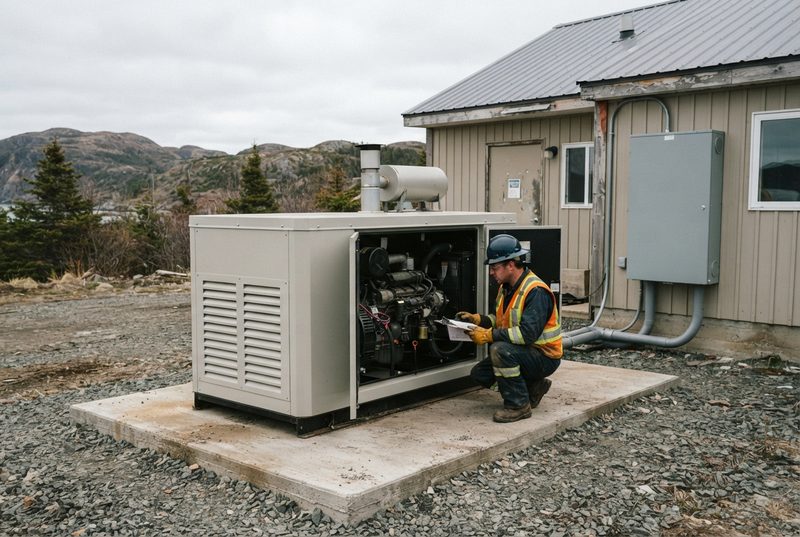
If you are planning a standby generator for a home or a commercial building, the part that does the real work when the power fails is the automatic transfer switch. It is easy to treat the switch as an accessory to the generator. It is not. The switch decides when the generator starts, what it feeds, and when the building goes back to utility power.
What the switch actually does
An automatic transfer switch sits between the utility service, the generator and the loads it covers. It monitors incoming utility power continuously. When that power drops out or moves outside an acceptable range, the switch signals the generator to start, waits for the output to stabilize, then moves the connected loads from the utility source to the generator. When utility power returns and holds steady for a set period, the switch shifts the load back and signals the generator to shut down and cool.
None of this depends on someone being present. That is the point of an automatic switch. A property with an unattended generator, or a home where the owner is often away, needs the transfer switch to work correctly every time, not only during a scheduled test.
Where it fits in the system
The switch is sized around what it needs to carry. A whole-building switch sits near the main service and covers everything downstream of it. A partial, or load-shedding, switch is set up to cover selected circuits only, chosen so a smaller generator can carry what matters most: life safety systems, refrigeration, sump pumps, key lighting and outlets, or equipment that cannot tolerate an unplanned shutdown.
Getting this right starts with an accurate load list before the switch is selected, not after. That is also where the generator itself gets sized, since a switch rated for the whole building means little if the generator behind it cannot carry the same load. Undersizing either one tends to show up during a real outage, which is the worst time to find out.
Automatic versus manual transfer switches
A manual transfer switch does the same basic job, but a person has to operate it. That means someone has to be present, know the sequence, and be willing to do it, sometimes outside in poor weather. Manual switches cost less to install and can suit a smaller property with a portable generator and someone reliably on site.
For anywhere unattended, for tenants who should not be expected to manage generator switching themselves, or for loads that need power restored within seconds rather than minutes, automatic is the standard choice.
What to ask when specifying one
A few questions are worth raising with whoever designs the system:
- Is the switch rated for the full building load or a defined subset of circuits.
- What is the transfer time, and does anything in the building need power back faster than that.
- Does the switch include a time delay before transferring back to utility power, to avoid nuisance switching during a brief blip.
- Is it located somewhere accessible for testing and service, and protected from the weather if installed outdoors.
- Who is responsible for periodic testing, and is that written into a maintenance plan.
These are the same questions a design-build electrical contractor should be asking before drawings are finalized. The transfer switch, the generator and the panel it feeds have to be specified as one system, not three separate purchases.
Common problems that get missed
A few issues turn up often enough to be worth checking specifically, rather than assuming a switch that looks fine is fine. Corrosion on switch contacts, from moisture or age, can cause a switch to hesitate or fail to make a clean transfer even though it appears to operate. A switch that has never been tested under an actual building load may pass a quick exercise cycle and still fail when asked to carry real demand. Settings for transfer delay and re-transfer delay are sometimes left at factory defaults that do not match how the building is actually used, causing nuisance transfers during short utility blips or unnecessary generator run time. None of these show up from a visual inspection alone, which is part of why periodic testing under load, not just a look at the enclosure, belongs in any maintenance plan for a system with an automatic transfer switch.
Talk to Puffin Power
If you are planning a standby generator for a home, a commercial building or a facility with critical loads, Puffin Power can work through transfer switch sizing and placement as part of the design. Call (709) 769-9713 or visit /contact.html to get started.
Published 2026-09-23 · About 4 minute read