
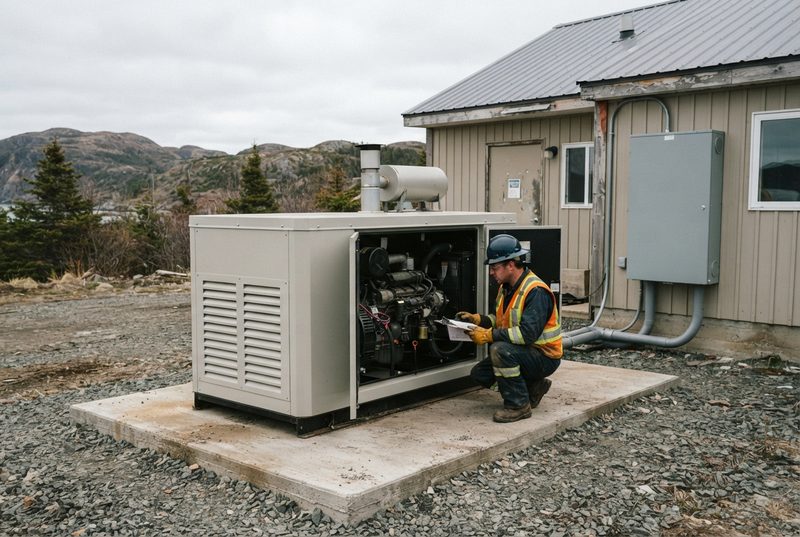
Commercial property owners and facility managers weighing a standby generator often ask for a size recommendation before anyone has looked at what the building actually needs to keep running. Getting this right starts with a proper load study, not a rule of thumb based on square footage.
Start with what has to stay running
Every commercial building has a different answer to what matters most during an outage. A medical or dental office may need life safety systems, refrigeration for medications, and enough lighting and outlets to continue seeing patients. A retail location may prioritize point-of-sale systems, refrigeration and enough lighting to operate safely. An office building may focus on life safety systems, elevators, and enough general power to keep a portion of the building functional. Warehouses and light industrial buildings often center on specific process equipment and security systems rather than general lighting. There is no generic answer, which is why the first step is always a walk-through and a load list specific to your operation, not a template.
Code requirements versus operational choice
Some loads are not optional. Life safety systems, emergency lighting, exit signs and fire alarm systems are required by code to have backup power in most commercial occupancies, and these requirements are set out through the Canadian Electrical Code and enforced by your provincial electrical inspection authority. Beyond that baseline, how much additional operational capacity to add, refrigeration, IT systems, production equipment, is a business decision based on what an extended outage actually costs your operation. Separating the code-required baseline from the operational choices helps clarify what you must have versus what you are deciding to invest in.
Calculating the load
A proper load calculation accounts for both running loads, what equipment draws continuously, and starting loads, the surge that motors and compressors draw when they first switch on. Getting this wrong in either direction causes problems: undersizing means the generator cannot start or sustain the building's actual demand during an outage, while oversizing means paying for capacity, fuel consumption and equipment cost the building will rarely use. This calculation should be done by an electrical contractor working from actual equipment specifications and utility data for the building, not estimated from a generic per-square-foot figure.
Fuel and site considerations
Commercial standby generators run on diesel, natural gas or propane, and the right choice depends on fuel availability at the site, run-time expectations during an extended outage, and local fuel supply considerations, particularly during a widespread regional event when fuel delivery itself may be constrained. Site placement also matters for a commercial installation: noise, exhaust, weatherproofing, and access for maintenance and refuelling all factor into where the unit goes and how it is housed.
The transfer switch and load priorities
An automatic transfer switch isolates the building from the utility grid when the generator is running and restores utility power automatically once it returns, which protects both the building's equipment and utility workers on the grid. For buildings with generators sized to cover only part of the total load, a load priority or shedding scheme within the transfer and distribution setup ensures the most important circuits, life safety first, then operational priorities, are served if total demand exceeds what the generator provides.
What to bring to the assessment
- A list of what must run during an outage, separated into code-required and operationally important.
- Recent utility bills or equipment nameplate data, so actual loads can be calculated rather than assumed.
- Any planned changes to the building's operations or equipment in the next few years, which affects sizing for the long term.
- Fuel availability and any site constraints on generator placement.
Talk to Puffin Power
Puffin Power, an authorized Generac dealer, sizes and installs standby power for commercial buildings across Atlantic Canada, starting with a proper load study. Contact us to schedule an assessment, or see our emergency service and turnkey electrical capabilities.
Published 2026-09-23 · About 3 minute read