
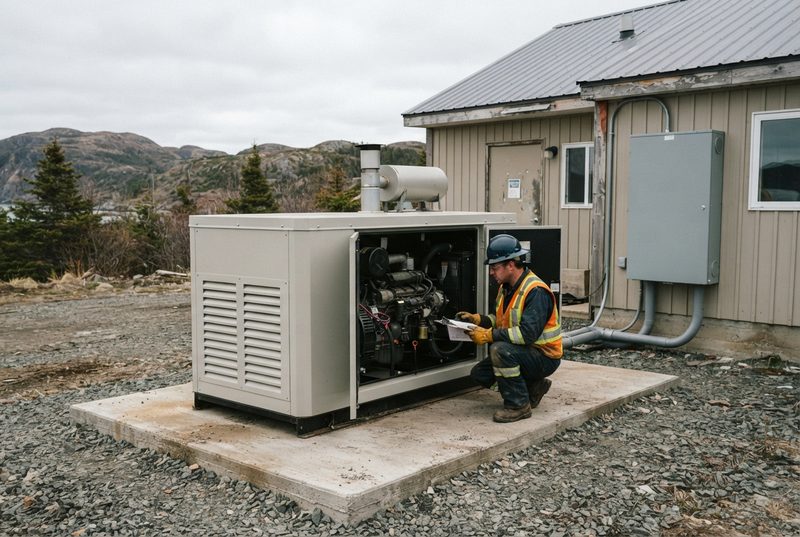
Choosing a fuel for a generator is less about preference and more about what is actually available at your property and what you are willing to manage in terms of storage and refuelling. Atlantic Canada's fuel landscape narrows the choice more than people expect.
Diesel
Diesel is a common choice for larger standby generators, particularly for commercial buildings and facilities with heavier loads. It stores reasonably well over time compared to gasoline, and diesel generators tend to be built for continuous or extended runtime. The tradeoff is an onsite fuel tank that needs to be sized, maintained and refilled, and fuel quality needs attention if the tank sits mostly full and undisturbed for long stretches, since diesel can degrade or pick up water over time.
Propane
Propane is widely available across the region and is a common fuel for both residential and commercial standby generators. It can be supplied from a bulk tank on the property, sized to the generator's runtime needs, or in some cases from smaller cylinders for portable units. Propane stores indefinitely without the degradation issues diesel can develop, which makes it a reasonable fit for a generator that might sit unused for long periods between outages. The property needs room for the tank and needs to arrange a supply contract with a propane provider.
Natural gas
Piped natural gas is not an option for most properties in this region. There is no natural gas pipeline network serving homes in Newfoundland and Labrador. In Nova Scotia, a small natural gas distribution utility serves parts of the Halifax area and a handful of other communities, but service is limited to specific neighbourhoods, not available province-wide, and used by only a small share of households. If you are unsure whether your property has access to piped gas, that is worth confirming directly with the local utility before designing around it. For nearly everyone else in Atlantic Canada, propane or diesel are the realistic options for a fixed-fuel standby generator.
Gasoline
Gasoline is mainly relevant for portable generators rather than standby installations. It is easy to source but does not store as well as propane or diesel over long periods, and running out mid-outage means finding an open station, which can be its own challenge during a widespread storm event. For a portable unit used occasionally, this is a manageable tradeoff. For anything meant to run unattended or for extended periods, it is less practical.
What actually drives the decision
In practice, the choice usually comes down to:
- What fuel is realistically available and serviceable at the property.
- Whether the generator needs to run for hours or potentially days during an extended outage.
- How much space is available for fuel storage.
- Whether the generator will sit unused for long stretches between run cycles, which favours propane's storage stability.
- Cost and availability of a supply contract from a local fuel provider, which is worth checking before committing to a fuel type.
Fuel storage and refuelling logistics
Whatever fuel you choose, plan for how it gets replenished during an extended outage, not just how the generator runs on day one. A propane or diesel tank sized only for a few hours of runtime can leave you without backup power partway through a multi-day storm event, exactly when demand for fuel delivery across the region is highest and suppliers are stretched thin. Ask your fuel supplier what their delivery commitments look like during a widespread outage, since a contract that assumes normal conditions may not reflect what is realistic when many customers need fuel at once. For a commercial building with a generator protecting critical operations, this is worth confirming in writing rather than assuming a supplier will prioritize your account when demand spikes.
Talk to Puffin Power
Puffin Power can help you work through which fuel makes sense for a home or commercial standby generator based on your site and how the generator will be used. Call (709) 769-9713 or contact us through /contact.html.
Published 2026-09-23 · About 3 minute read