
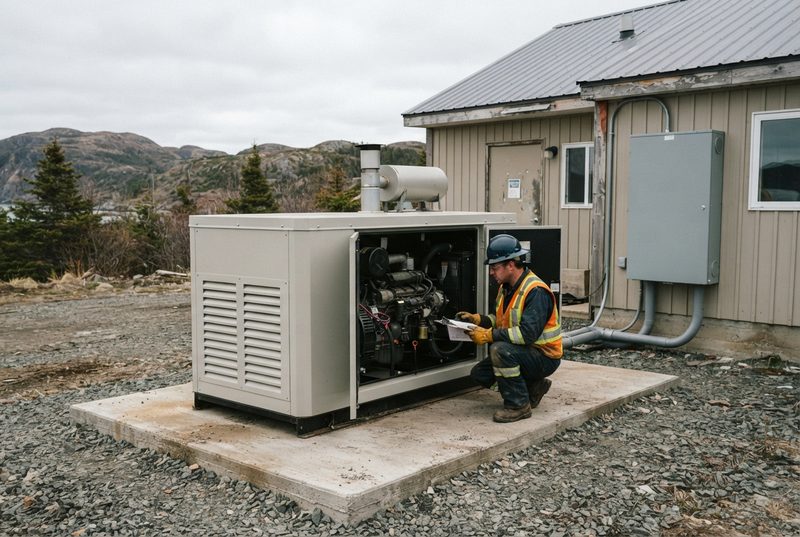
A standby generator that has not been maintained is a liability dressed up as a safety net. The engine sits idle for months at a time, batteries lose charge, fuel degrades, and small problems go unnoticed until the one moment the generator actually needs to run. A maintenance schedule is what closes that gap.
Why generators fail when you need them
Most standby generator failures are not dramatic. A battery too weak to crank the engine. A fuel line that has not been checked since installation. A block heater that quietly stopped working months ago. Coolant or oil levels that drifted low. None of these show up on a walk past the enclosure. They show up when the utility power drops and the generator does not start, or starts and cannot carry the load.
What a maintenance visit typically covers
The exact scope depends on the generator, its fuel type and its run hours, but a maintenance visit generally checks:
- Battery condition, charge and terminal connections.
- Oil and coolant levels, and oil changes on the manufacturer's interval.
- Fuel system condition and fuel quality, particularly on diesel units that sit for long periods.
- Air filters and belts.
- Block heater and battery charger operation.
- Automatic transfer switch operation and exercise cycle.
- A load test or exercise run under real or simulated load, not just an unloaded start.
That last point matters more than it sounds. A generator that starts but has never been tested under load can still fail the moment it is asked to carry the building.
How often maintenance should happen
Manufacturers publish service intervals based on run hours and calendar time, and those intervals vary by generator size, fuel type and duty cycle. Rather than guessing at a schedule, check the maintenance requirements listed in your generator's owner's manual and warranty terms, since running past those intervals can also affect warranty coverage. For a business, it is worth confirming who owns the responsibility for scheduling this: the electrical contractor, a service agreement, or in-house facilities staff. For a homeowner, it usually means an annual service visit plus routine exercise cycles the generator runs on its own.
Weekly exercise cycles are not optional
Most standby generators are programmed to run a short self-test on a set schedule, often weekly, whether or not there is an outage. This exercise cycle keeps the engine lubricated, the battery charged and the fuel moving. If your generator's exercise cycle has been silently failing, or if no one has confirmed it is even set, that is worth checking before assuming the unit is ready.
What building owners and homeowners should track
A simple log, even a basic one, helps catch problems before they become failures:
- Date of each maintenance visit and what was done.
- Any fault codes, alarms or unusual noises reported by staff or family.
- Results of the most recent load test.
- Fuel level and fuel age, particularly for diesel systems.
If you manage a commercial building with a standby generator protecting critical loads, this log is also useful for insurers, who may ask for maintenance records after any claim involving a power failure.
What a service agreement should include
If you would rather not track maintenance intervals yourself, a service agreement with a qualified contractor can cover it. A reasonable agreement should specify how often visits happen, what is checked and tested at each visit, whether load testing is included or billed separately, and how quickly the contractor responds if the generator faults or fails to start between scheduled visits. It should also spell out who supplies parts and consumables, such as filters and oil, and whether emergency callouts are covered under the same agreement or billed separately. For a commercial building where the generator protects tenants, refrigeration or life safety systems, this kind of agreement is often worth the cost simply for the certainty of knowing the equipment is being checked on schedule rather than whenever someone remembers to call.
Talk to Puffin Power
Whether you have a home standby generator or a system protecting a commercial building, Puffin Power can review what maintenance it is due for and help set a schedule that fits how the equipment is actually used. Call (709) 769-9713 or reach out through /contact.html.
Published 2026-09-23 · About 3 minute read