
A bid is priced from drawings. Once the subcontract is signed, its scope exhibit is what both sides point to. When the exhibit says only "per plans and specs, Division 26", every gap between the electrical subcontractor and the communications, security, fire alarm, mechanical and utility work is open to dispute, and those disputes can come back as change orders. This post is a way to write the exhibit so the gaps are assigned before signing.
Why per plans and specs falls short
Drawings show what is to be built. They do not always say who supplies it, who installs it, who makes the final connection and who tests it, and spec sections written by different consultants can overlap or disagree. A useful exhibit answers four questions for every item on a trade boundary: who supplies, who installs, who connects, who tests.
Start from the specification divisions
MasterFormat is developed and maintained by the Construction Specifications Institute and Construction Specifications Canada, and CSI describes it as the framework relied on across North America to organize project requirements. If your specification follows it, use its divisions as the skeleton of the exhibit. The ones that touch electrical work are:
- Division 23, Heating, Ventilating and Air Conditioning
- Division 25, Integrated Automation
- Division 26, Electrical
- Division 27, Communications
- Division 28, Electronic Safety and Security
Give each division one line: included, excluded, or by others, with the other party named. A blank line is where a dispute can start. Then read the Division 23 and 25 sections for words like power, wiring, conduit and connection, since that is where electrical work can hide in another trade's section.
Do not assume fire alarm sits in Division 26. The province's master specification for publicly funded buildings lists its multiplex fire alarm section, 28 31 00.01, under Division 28. An exhibit that names only Division 26 can leave fire alarm with no one.
Name the boundaries with other trades
Write each boundary as a short line. Start with these:
- Mechanical equipment: who supplies and sets disconnects, starters and variable frequency drives, who runs power to the unit, who runs control wiring, who makes the final connection
- Controls and automation: who supplies low voltage control wiring, and whether electrical provides conduit and boxes only
- Communications and security: pathways (conduit, boxes, backboards) versus cabling, devices and terminations
- Generator and transfer switch: supply, setting, fuel and exhaust connections, and start-up testing
- Owner-supplied equipment: who receives and stores it, who installs it, who connects it
- Core drilling, firestopping and patching: who does each, and who pays
A line written well leaves little to argue about. For example: "Rooftop units supplied and set by mechanical. Disconnects supplied, installed and wired by electrical. Control wiring by Division 25. Start-up by mechanical, with electrical attending." The same pattern works for card readers, where conduit and back boxes might sit with electrical and cabling, devices and programming with security.
Fire alarm needs its own line. In this province, plans for fire alarm installation must be approved by the fire commissioner, and installation and verification of new systems must comply with the National Fire Code of Canada (Fire Protection Services Regulations, NLR 45/12, section 7). Say who supplies and installs devices and wiring, who submits the plans, and who arranges and pays for verification.
Utility work, permits and temporary power
These three sit partly outside the drawings, so they are easy to leave unassigned.
Utility. Newfoundland Power connects a new service only once, among other things, a permit is in place, it has approved the meter location, any contribution in aid of construction (CIAC) has been signed for and paid, a service contract is complete and the inspection authority has authorized the connection. Name who makes the service request, who supplies the loads and single-line, who pays any CIAC and who signs the service contract.
Permit. In St. John's the City issues electrical permits only to contractors it licenses, and deficiencies found at service inspection go to the contractor holding the permit. Elsewhere the province issues permits to registered electrical contractors, and a commercial application needs detailed electrical plans. Name the permit holder, who prepares the plans, and who pays permit fees and any premature inspection fee.
Temporary power. In St. John's every temporary power installation needs an electrical permit, generators included, and temporary supply must be disconnected and removed before the permanent service is approved unless a cut-over period is allowed. Newfoundland Power charges the customer the cost of connecting a temporary service. Say who applies, who pays, who maintains it, who removes it, and who covers any cut-over.
Testing, commissioning and close-out deliverables
List close-out items as deliverables with a point in the schedule, not as a reference to "close-out documents". A starting list:
- Inspection certificates and the authorization to connect
- Fire alarm verification reports
- Test reports for the equipment the specification names, by section number
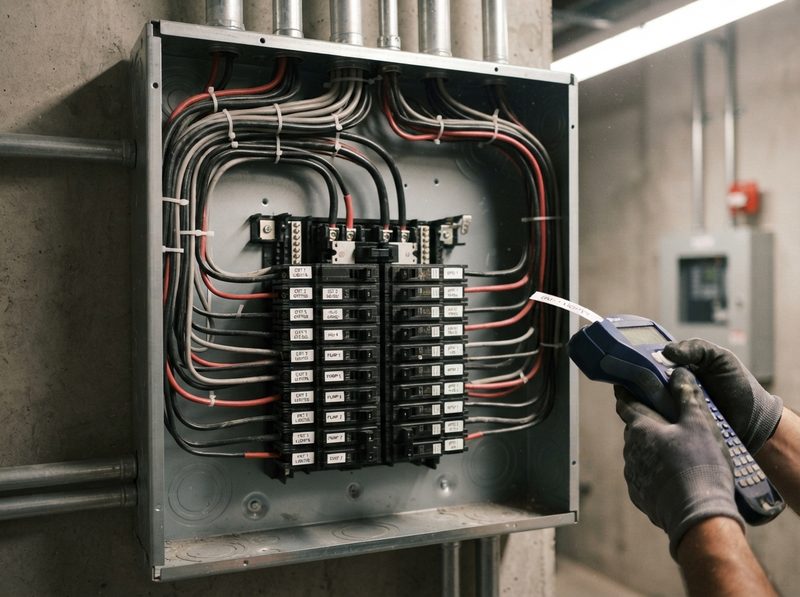
- Panel schedules, circuit directories and equipment labelling
- As-built drawings, covered in what as-built drawings should include at handover
- Operation and maintenance manuals, warranties and owner training
- A final inspection once temporary wiring and equipment are removed, where the authority requires one
Add who attends commissioning for systems that cross trades, such as fire alarm interlocks with mechanical equipment, or a generator with its transfer switch.
Carry bid clarifications into the subcontract
Make sure bid-day clarifications, assumptions and exclusions land in the contract documents. Attach the subcontractor's final scope letter as an exhibit, or copy its line items into yours, and say which document governs where they conflict. List the drawings, specification sections and addenda the price was based on, by number and date, so a later revision shows up as a change. Where an allowance was carried, state the amount, what it covers and how unspent money is handled. Where you accepted an exclusion, name who now carries it. How to read an electrical subcontractor's exclusions covers reading the list, and what an electrical estimator needs in a bid package covers what to give bidders in the first place.
Review the scope before signing
Walk through the exhibit with the subcontractor's estimator and project manager, not only whoever signs. The people who priced it know where it is soft. Before signing, check that:
- Every division line says included, excluded or by others, with a name.
- Each trade boundary answers supply, install, connect and test.
- The permit holder, utility requests and temporary power are assigned.
- Allowances show amounts and how they are reconciled.
- The drawing, specification and addenda list matches the bid.
- Close-out deliverables are listed with dates.
- The exhibit says which document governs in a conflict.
Changes after signing should then be priced and documented the way electrical change orders describes.
Talk to Puffin Power
Puffin Power is licensed as an electrical contractor in Newfoundland and Labrador and works across the Avalon and Conception Bay, with projects elsewhere by arrangement. Our design-build estimate is a line-item electrical estimate by system, with allowances and exclusions stated, so the subcontract scope can be written straight from it. Send the drawings and specification through our contact page.
Published 2026-10-19 · About 6 minute read