
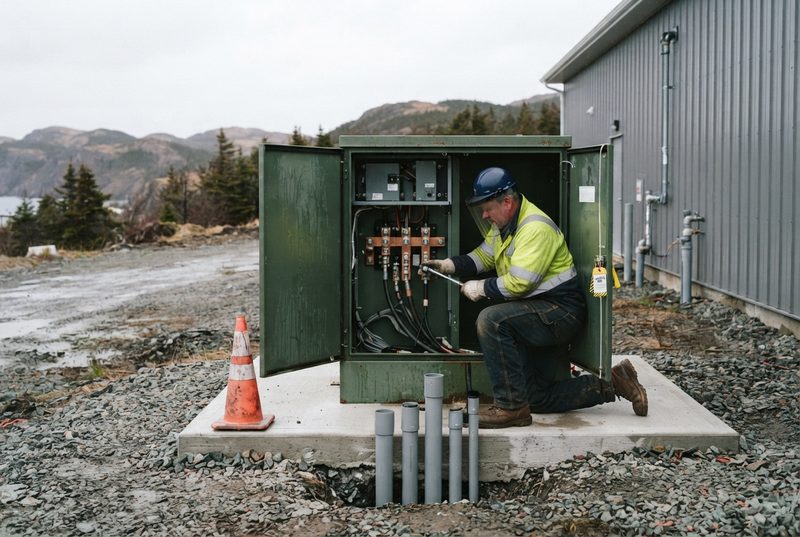
If you hold back money from an electrical subcontractor in Newfoundland and Labrador, the Mechanics' Lien Act sets the percentage, the clock and the consequences. This post covers the parts that matter when the electrical scope is the last thing between you and completion. It is general information, not legal advice. For a specific contract, ask your lawyer.
What the Mechanics' Lien Act requires
Section 12(1) requires the person primarily liable on a contract to retain 10% of the value of the work and materials done, placed or provided. The amount is retained as the work is done, for 30 days after completion or abandonment of the work. The holdback runs down each tier: you hold back from the electrical sub as the owner holds back from you.
Under section 12(5), lien claimants below the sub can look to the retained amount as a charge. Under section 12(6), payments up to 90% made in good faith before written notice of a lien, whether owner to contractor, contractor to subcontractor or subcontractor to subcontractor, discharge the payer to the extent of the lien. Holdback paid early, outside the Act's release routes, does not get that protection. After the 30 days, section 12(7) allows payment of the holdback unless proceedings to enforce a lien or charge have started.
When a contract counts as complete
Everything depends on the completion date. The Act defines "completion of the contract" as substantial performance, not necessarily total performance. Under section 2(2), a contract is substantially performed when both of these are true:
- The work, or a substantial part of it, is ready for use or is being used for the purpose intended.
- The work left to do can be completed or corrected for no more than 3% of the first $250,000 of the contract price, 2% of the next $250,000 and 1% of the balance.
The arithmetic on round numbers: on a $1,000,000 contract the ceiling is $7,500 plus $5,000 plus $5,000, or $17,500. On a $400,000 contract it is $7,500 plus $3,000, or $10,500. A long electrical punch list can sit above that ceiling on a modest contract, even when the building looks finished.
Section 2(3) adds a rule for delay. Where the work, or a substantial part, is ready for use or in use, and the remainder cannot be completed expeditiously for reasons beyond the contractor's control, the value of the work still to be done is deducted from the contract price in determining substantial performance. Raise it with your lawyer if long-lead equipment is late.
Lien registration and expiry periods
- A contractor or subcontractor may register a claim for lien before or during the contract, or within 30 days after completion or abandonment of the contract or of the subcontract (section 22(1)).
- Materials, services and wages each have their own 30-day trigger: the last material provided, completion of the service, or the last work for which the lien is claimed (section 22(2) to (4)).
- A lien never registered stops existing when the section 22 period ends (section 23(1)). A registered lien stops existing 90 days after the work is completed unless an action is started and a certificate is registered (sections 23(2) and 24(1)).
So the date you treat as completion decides when the window closes and when the holdback can be released. Claims go to the Registry of Mechanics' Liens, and the province's Companies and Deeds Online service lets you search it, with a fee for each search and each lien viewed. Results show claimant and debtor names and the property location. The registry encourages clients to consider a lawyer or professional search firm, since title searching can be complex. Search the property on the day you plan to release funds.
Early release of holdback
The Act has two early-release routes. The first is more likely to matter on an electrical subcontract.
Subcontract completion certificate. Where the main contract is supervised by an architect, engineer or other person upon whose certificate payments are made, section 12(2) can reduce the amount retained on the main contract by 10% of the price of a subcontract made directly under it. It applies 30 days after that person certifies the subcontract completed to their satisfaction and the certificate has been given to the person primarily liable on the main contract and to the subcontractor. It does not operate while a lien under the subcontract is preserved. Section 12(3) treats the subcontract as complete, for the lien deadlines, no later than the certificate. If the certifier neglects or refuses to issue a certificate, section 12(4) lets a court, on application, make an order with the same effect as the certificate. If the electrical scope finishes well ahead of the building, ask the consultant whether such a certificate is available.
Large contracts. Section 12.1 provides for holdback release after each anniversary of the start of work where the contract price exceeds $20,000,000 (or a greater prescribed amount), the completion schedule is longer than one year, no lien proceedings have started and notice of early release is given. Section 12.2 requires written notice to everyone providing services or materials, a posting on the main job site and publication in the Gazette.
Electrical items that hold up completion
The Act does not list electrical items. "Ready for use" and the percentage ceiling are what a punch list gets measured against. Track these by name and date:
- Inspection and certification. Outside St. John's, the provincial regulations have the registered contractor notify the Government Service Centre that the installation is ready for inspection and certification, unless a representative certifies it. In St. John's, the City's electrical by-law says no one may cover electrical work that has not been inspected and approved.
- Energization. Confirm who books the utility and who is on site for the connection.
- Deficiencies. One list, with owners and closing dates.
- Testing records, panel schedules and labels, plus any life safety testing in the electrical scope.
- Close-out documents. As-built drawings, manuals and warranties.
- Open pricing. Settle change orders and reconcile allowances before close-out, so the contract price and holdback are right.
Whether an item stops substantial performance is a legal question. The list shows what evidence to hold.
Prompt payment is still under review
In 2024 the province consulted on the time limit for registering liens, a prompt payment framework to provide a remedy for late payments, and an alternative process for timely dispute resolution. It now lists the review among its past consultations. The House of Assembly's progress of bills, dated June 3, 2026 when we checked in October 2026, showed no bill with a Mechanics' Lien or prompt payment title. Check that list again before relying on this. Until something changes, payment timing comes from your contract.
Federal work is different. The Federal Prompt Payment for Construction Work Act, in force since December 9, 2023, applies to construction projects on federal real property. Once the federal government pays a contractor's proper invoice, the contractor must pay each subcontractor for the invoiced work it covered no later than the 35th day after the government received that invoice. On federal property, read the Act and its regulation.
Billing the electrical scope cleanly
Clean billing makes holdback easier to defend:
- Break the schedule of values out by system, so percent complete is checkable against the work.
- Show holdback as its own line on every pay application, with a running total.
- Record the last day of work and the last delivery of materials for each billed item. Those dates feed the section 22 deadlines.
- Keep the holdback release date, the registry search result and the approver in one file.
Talk to Puffin Power
Our design-build estimate is line-item by system, with allowances and exclusions stated, which gives a schedule of values a clean starting point. Request pricing through contact.
Published 2026-10-19 · About 6 minute read