
Takeover, holdback release and the owner's acceptance all wait on paper. Electrical close-out depends on outside parties: the inspection authority, the utility and any fire alarm verifier. Their paper can arrive after the work itself is done. A list agreed at award costs less than a scramble at completion. This post covers the documents. For the drawing set, see what as-built drawings should include at handover.
What takeover waits on
Under the CCDC forms, Ready-for-Takeover is not reached on finished work alone. In CCDC 2-2020 the conditions include an occupancy permit, final cleaning, delivery of operation and maintenance documents and as-built drawings. The 2025 construction management forms list similar conditions plus scheduled demonstration and training. Several depend on someone other than your electrical subcontractor.
So list the electrical deliverables in the subcontract, give each a due date, and ask for them in stages. Do not wait for the last week.
Inspection certificates and connection authorization
Outside St. John's, the Government Service Centre issues connection authorizations and certificates of inspection on behalf of the Chief Electrical Inspector. A registered contractor submits a representative inspection report first. Some contractors are designated to certify all or portions of their own installations, subject to audit, and issue these themselves after submitting the report. That designation is noted on the contractor's registration certificate, so ask to see it.
Collect:
- the certificate of inspection or electrical certificate, and the connection authorization;
- written confirmation that the utility has received the authorization;
- trench inspection approvals, where the province requires them before backfilling;
- in St. John's, the final inspection record for removal of temporary power;
- evidence that deficiencies were cleared. St. John's issues them to the contractor holding the permit and requires correction before service authorization.
Read the certificate against the contract. In St. John's the permit's detailed description of the work appears on the electrical certificate, and work not listed may need a new permit. If the wording is thinner than the scope you bought, raise it now.
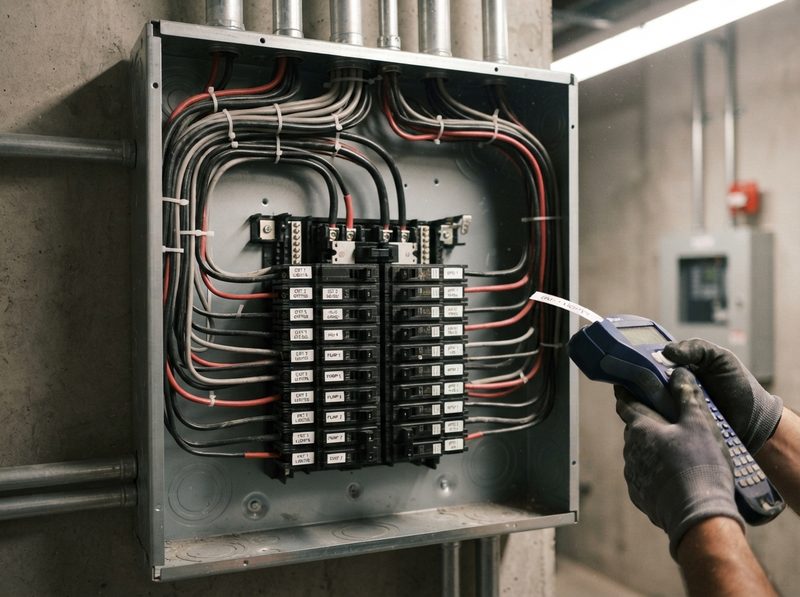
Then look at the service panel. On provincially permitted work, the Electrical Regulations require the contractor to fix a permanent label to the front of the service panel, showing its registration number and the year the installation was completed. Where a panel is replaced, the contractor must also transfer the panel's recorded information to a file the owner keeps.
Test and verification reports
Fire alarm has its own rules. Under the provincial Fire Protection Services Regulations, fire alarm plans are approved by the fire commissioner, and verification must be done by a person the fire commissioner considers certified and licensed for the work. Collect the signed verification report and the verifier's licence details. If a separate contractor handles fire alarm, confirm in writing who books the verification.
For everything else, the test list is whatever your specification and the equipment manufacturers require. Ask the subcontractor at award for the tests it will run, the forms it will use and who will witness them. At close-out collect the completed, dated records for each, and file them by specification section so a reviewer can find them.
Operation and maintenance information
Delivery of operation and maintenance documents is a Ready-for-Takeover condition in the CCDC forms, so treat it as a takeover item, not a courtesy. A usable electrical package includes:
- an equipment list with model and serial numbers;
- cut sheets and manufacturer manuals;
- start-up and commissioning reports;
- panel schedules that match the as-built circuits;
- spare parts lists;
- maintenance intervals the owner can drop straight into a preventive maintenance schedule;
- a sign-in sheet for owner demonstration and training, where specified.
The owner should hold the master set, along with permits and inspection records, as described in keeping electrical records ready for insurers and inspectors.
Warranties and when they start
Write the warranty start into the close-out record. Under CCA 1-2021 the one-year subcontract warranty runs from Ready-for-Takeover. Under CCDC 2-2020, warranty periods link to the same milestone, and the 2025 construction management forms follow suit. Early occupancy starts the warranty early for the part occupied. When a floor or phase is handed over early, note the date for that area and keep the subcontractor's records of it.
Manufacturer warranties are a separate matter. Ask for each major item's start date in writing, so the owner is not left guessing which clock is running.
Deficiency lists that actually close
Under the Newfoundland and Labrador Mechanics' Lien Act, a contract is substantially performed when the work, or a substantial part of it, is ready for use and the cost to finish or correct what remains is within a cap set as a percentage of the contract price. Substantial performance starts the holdback clock, so the price of the deficiency list matters, not just its length.
A list that closes has:
- each item numbered, located and priced;
- one responsible party and a due date per item;
- a stated proof of closure, such as a test record, a photo or an inspector's sign-off;
- re-inspections requested by the subcontractor, not left to the GC;
- written, dated closure of each item.
Unfinished items can also cost money at occupancy. The City of St. John's fee schedule lists a conditional occupancy permit whose fee reflects the cost of outstanding items. In Mount Pearl, a building cannot be occupied without an occupancy permit, and the City does a final inspection before it issues one.
Tie close-out to the payment schedule
Holdback and final payment are where the leverage sits, so connect the paper to the money.
- Holdback. The Mechanics' Lien Act requires 10 per cent to be retained for 30 days after completion, and has its own release rules. Talk to your lawyer before tying release to anything else.
- Workers' compensation clearance. WorkplaceNL says to get a clearance letter when you award a contract and each time you pay the contractor. A clearance obtained online is valid for 45 days, so request a fresh one before final payment.
- Statutory declaration. Under CCDC 2-2020, each payment application needs evidence of workers' compensation compliance and a CCDC 9A declaration from the contractor. Check how your subcontract flows that down.
- A close-out line. Consider a separate line in the schedule of values for close-out documents, released when the package is complete and checked.
Talk to Puffin Power
Puffin Power is licensed as an electrical contractor in Newfoundland and Labrador and works across the Avalon and Conception Bay. Ask for our prequalification package through our contact page, or send your close-out requirements with the bid package so they are priced from the start. The scope of our turnkey electrical service lists as-built drawings and close-out documentation.
Published 2026-10-19 · About 5 minute read