
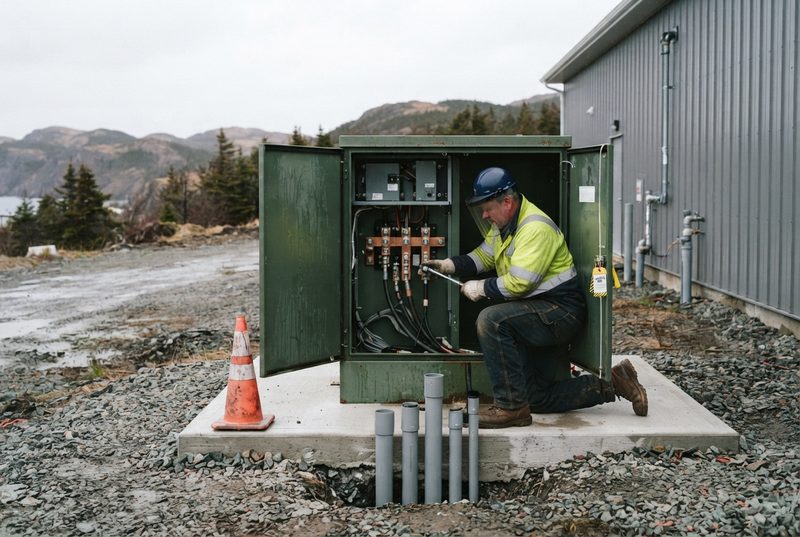
Permanent power is one of the last things a building needs and one of the first things to request. A building can be close to finished while its service still waits on a utility design, an approval or a line crew. This post follows Newfoundland Power's commercial checklist (October 2024) and its Service and Metering Guide, Revision 3.0. Newfoundland Power serves most of the island. Where NL Hydro is the supply authority, contact NL Hydro for its procedures.
Start the request before construction
Newfoundland Power asks customers to contact it before construction begins or early in the construction phase. Use the online New Service Connection Form, or phone 737-5408 in St. John's or 1-888-491-5066 toll free.
Once the account is set up you are given a Technical Work Request (TWR) number. Quote it on every call. Two practical points:
- If you or your electrician will call for the owner, the account needs a note giving the utility permission to discuss it with you.
- Give an email address, so automatic construction updates reach the project team.
A technologist then contacts you about your requirements, and a site visit may be needed.
What the technologist will ask for
The commercial checklist lists what to have ready. Assemble it as one package:
- Survey or real property report, and the name of the registered property owner
- Voltage, amperage and number of phases
- Single-line diagram of the service entrance and metering arrangement
- Number and size of service entrance conductors
- Connected load split into heating, lighting and motor loads, with every motor listed separately
- Proposed hours of operation, noting loads that will not run at the same time
- Estimated annual kilowatt-hours and demand
- The date the service is required, and a copy of the site plan
Several of these come from your electrician or consultant. For three-phase service the guide asks for the single-line and loads at the earliest stage of planning, so ask for them at schematic stage, not permit stage. The utility will not order equipment until it has approved the information and the customer agrees with its proposed method of service.
The utility's published timeline
The checklist gives approximate timeframes and says they may be shorter or longer depending on location and complexity:
- Infrastructure design: 1 to 3 weeks
- Approvals with the appropriate agencies: 1 to 6 weeks
- Power line construction: 3 to 6 weeks
- Metering commissioning: 2 to 3 days
- Permit, inspection and authorization: usually 2 to 3 days before the authorization number reaches the utility
- Service connection: 1 to 2 weeks
It also warns of delays from weather and system maintenance. The checklist does not say whether the stages overlap. If they run back to back, the weeks add up to roughly 6 to 17, plus a few days for metering and inspection. That is our arithmetic, not a utility commitment. Ask the technologist for a site schedule. For padmount transformers and equipment timing, see padmount transformers: what developers should know and long-lead electrical equipment and your schedule.
Easements, Crown land and final grade
The checklist says difficulty obtaining easements may delay the connection. If the service route passes through Crown land, the guide says the utility seeks approval, which can take 8 to 24 months. If the route crosses the customer's private property, the customer must supply and maintain a clear route, and proof of ownership or legal land surveys are needed before easements are drafted.
Find out at site selection, not at foundation stage, whether the route touches Crown land. The checklist also tells applicants to ask the municipality, and the province where Crown land is involved, what other approvals the project needs when applying for the building permit.
Final grade matters too: the checklist asks that the property be at final grade before the utility's construction phase starts. Tie your civil schedule to that window. See coordinating electrical with civil work on a new build.
Contribution in aid of construction
Contribution in aid of construction (CIAC) is the cost a customer pays the utility for providing service, based on the property's location in relation to the electrical system or on the service requirements. The checklist gives one example of when a cost may apply: new construction more than 85 metres from existing power lines. Newfoundland Power must use one of two CIAC policies to set the amount. Commercial services fall under the general service policy, which covers line extensions and upgrades.
Where three-phase power is not readily accessible, the guide describes a budgetary estimate and a non-refundable down-payment of 10 per cent of the extension cost before detailed engineering design begins. CIAC payments must be received before the service connection is permitted.
Newfoundland Power also requires a security deposit on some new accounts, including where the applicant is a limited liability company incorporated for less than two years. A company formed for the project may meet that test. Ask the owner early who will sign the CIAC quote and the account, and when they can pay.
Conditions before the service is energized
Clause 2.05 of the guide lists what must be in place before the utility connects a new service. Turn it into a close-out list:
- An electrical permit from the authority having jurisdiction: the City in St. John's, the provincial Department of Government Services elsewhere
- The service request made, with site plan, survey, single-line, loads and conductor details supplied
- The meter location, capacity and attachment point approved by the utility. A service moved from the approved location without its consent will not be connected until it is put back.
- A signed CIAC quote acceptance and payment, if CIAC applies
- The service contract completed and panel covers in place
- The authority having jurisdiction's authorization to connect
- Easements and clearances in place
Two items catch schedules. If the design cannot meet the guide, the customer needs the utility's written decision before ordering or installing service entrance equipment, and in a dispute its employees will not honour verbal conversations. And padmount work carries its own inspections. The electrician's checklist says to notify the utility before concrete is poured so it can inspect the transformer pad and the primary duct bank, and again when the ground grid is ready. The guide adds that concrete poured without approval restarts the process so the utility can inspect the ground loop, reinforcing bars, duct and trench. Book the inspection with the civil crew before you book the pour.
In St. John's, a City advisory in effect since 1 January 2026 requires all utility-supplied equipment, including conductors and current transformers, to be installed before the service inspection. Failure to comply results in a deficiency notice and may incur a premature inspection fee. Contractors contact Newfoundland Power directly when they are ready for that equipment to be installed.
Who on your team owns each step
- Owner or developer: sets up the account, authorizes third-party callers, supplies the survey and proof of ownership, signs the CIAC quote and service contract.
- General contractor: controls final grade, raises Crown land questions early, schedules inspections ahead of concrete, holds the TWR number.
- Electrical subcontractor: provides the loads and single-line with the consultant, requests the meter location, arranges the permit, inspection and authorization, tells the utility when the site is ready for metering.
- Newfoundland Power: designs, seeks approvals, builds the line, commissions metering, connects.
Name one person on the GC side to check each step weekly against the in-service date. The utility notes that printed copies of its guide may be outdated, so confirm the current version.
Talk to Puffin Power
Puffin Power is licensed as an electrical contractor in Newfoundland and Labrador and works across the Avalon and Conception Bay. For underground feeds, transformer pads and duct banks, see our underground infrastructure service. Send your single-line, load figures and in-service date through our contact page and we will price the service entrance and underground scope with the utility steps built into the schedule.
Published 2026-10-19 · About 6 minute read